Published · Last updated · Rapid Water Damage Restoration Illinois
On July 1 and 2, 2023, a series of thunderstorms dumped extraordinary rain on Chicagoland — 8.96 inches in Berwyn, 8.6 inches in Cicero, and 8.12 inches in Garfield Park over 24 hours, a storm so intense it exceeded what hydrologists consider a 100-year event in some locations. The result: at least $500 million in damage, more than 70,000 flooded basements, and a sobering lesson for Illinois homeowners. Thousands of those basements had sump pumps — but the pumps were overwhelmed, lost power, or simply failed when they were needed most. In a region where basement-heavy housing stock meets intense storm seasons, understanding sump pump failure isn't optional. It's essential.
Why Sump Pumps Fail at the Worst Possible Moment
Sump pump failure almost never happens on a dry, calm day — it happens during the storms that put the most stress on the system. The most common cause is power loss: when heavy storms knock out electricity, a standard electric sump pump stops instantly, right as groundwater is rising fastest. The second leading cause is float-switch failure — the float that triggers the pump can get stuck on the pit wall, tangled in debris, or wear out over time, leaving the pump idle while water climbs. Undersizing is another frequent culprit: a pump that handles normal spring rains may be unable to keep up with a 100-year storm's inflow, running constantly until it overheats or the pit simply overflows. Clogged or frozen discharge lines prevent water from leaving even when the pump works perfectly — in Illinois, discharge pipes can freeze solid in winter and clog with sediment or ice year-round. And simple age matters: pumps wear out, check valves fail, and pits accumulate silt that reduces capacity.
The Chicagoland Factor: Basements, Clay Soil, and Combined Sewers
Chicagoland's housing stock makes sump pump failure especially punishing. Much of the region's housing — from Chicago's classic bungalows to mid-century ranch homes in the suburbs — sits on full basements dug into clay-heavy soil that drains poorly and funnels groundwater toward foundations. Many older neighborhoods also run on combined sewer systems, where stormwater and sewage share the same pipes; during extreme rain, those systems surcharge and push water back through foundation drains and floor drains alike. In July 2023, rainfall even exceeded the capacity of the deep tunnel system and McCook Reservoir, triggering combined sewer overflows. When municipal systems are overwhelmed, your sump pump is your last line of defense — which is exactly why its failure during big storms is so devastating. If you own a basement in Chicagoland, your sump pump deserves the same maintenance attention as your furnace.
Battery Backup Systems: Your Pump's Safety Net
Because power loss is the single most common trigger of sump pump failure, a battery backup system is the most important upgrade most Illinois homeowners can make. A battery backup sits alongside your primary pump with its own float switch and a deep-cycle battery; when the power dies or the primary pump can't keep up, the backup kicks in automatically. Look for a system with enough capacity to run for several hours — storm outages rarely last minutes. Maintain the battery the way you'd maintain a car battery: check connections, keep terminals clean, test the system by unplugging the primary pump and pouring water into the pit, and replace the battery on schedule before it degrades. Add a high-water alarm — a simple device that sounds when water rises past a set point — so you're alerted even if you're asleep upstairs. Together, a battery backup and an alarm turn a silent failure into a problem you can act on.
Water-Powered Backup Pumps: A Second Line of Defense
For homes on municipal water, a water-powered backup pump offers another layer of protection that doesn't depend on batteries or electricity. These devices use your home's water pressure to siphon water out of the sump pit — no motor, no battery to maintain. They activate automatically when the pit water rises too high, making them a true set-it-and-forget-it backup. The trade-offs are real: they consume municipal water while running, which adds to your water bill, and they discharge at a slower rate than electric pumps, so they're a supplement, not a replacement, for a properly sized primary pump. They're also unavailable for homes on private wells. Many Illinois homeowners pair a primary electric pump with both a battery backup and a water-powered backup — belt, suspenders, and a spare belt for the next July 2023.
The Maintenance Checklist That Prevents Sump Pump Failure
A sump pump is mechanical equipment, and like any equipment, it fails without maintenance. Run through this checklist each season: test the pump by pouring a bucket of water into the pit and confirming it activates, runs, and shuts off properly. Inspect the float switch for free movement — it should not stick, tilt, or catch on the pit walls or the power cord. Clean the pit of silt, gravel, and debris that can clog the intake screen. Check the discharge line outside your home: it should be clear, directed well away from your foundation, and not frozen or crushed. Verify the check valve — the one-way valve on the discharge pipe — prevents water from flowing back into the pit when the pump stops. Listen to the pump's motor for grinding or unusual noise, and note the pump's age so you can plan replacement before failure rather than after a flood.
What to Do Right Now If Your Basement Is Flooding
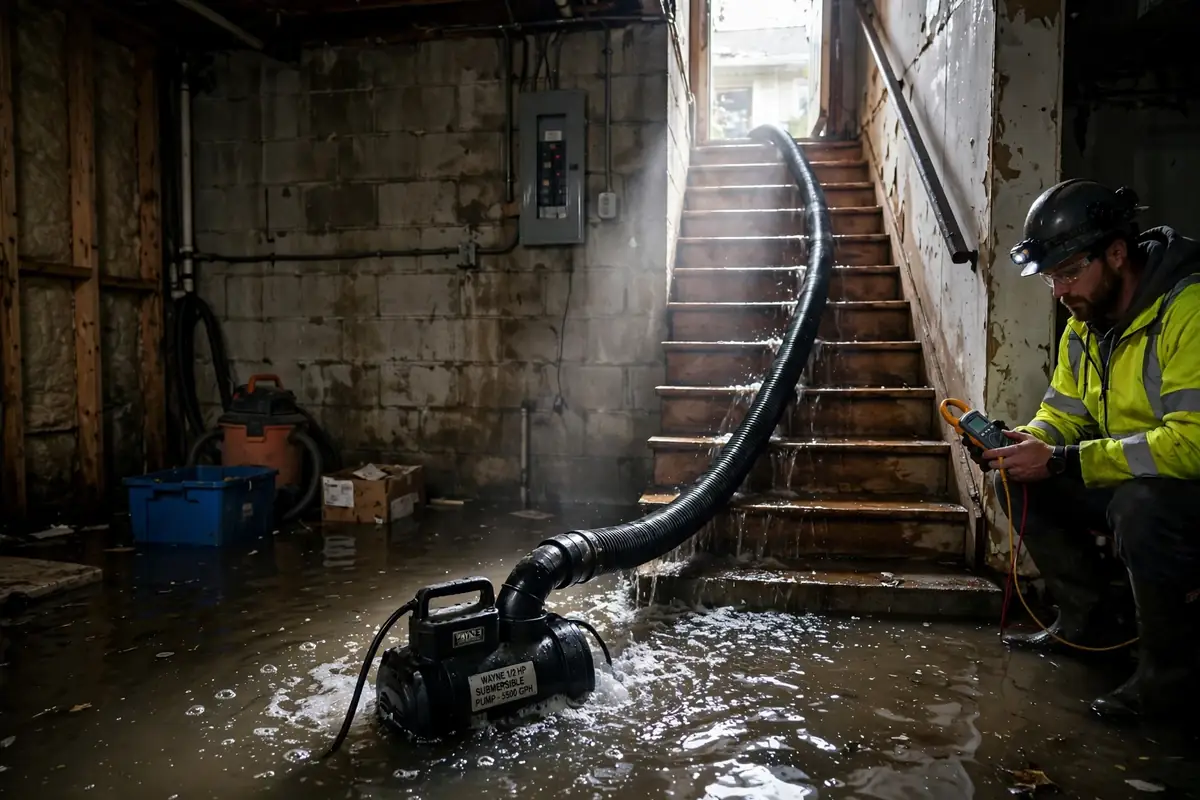
If water is rising in your basement as you read this, act in this order. First, stay safe: do not walk through standing water if it may be in contact with electrical outlets, appliances, or your electrical panel — electrocution is a real risk. If you can reach your breaker box safely, cut power to the basement. Second, if the sump pump has power but isn't running, check the float switch and the breaker — a tripped breaker or a stuck float is sometimes the whole problem. Third, if the discharge line is frozen or blocked, clearing it may restore pumping. Fourth, call Rapid Water Damage Restoration Illinois at (773) 200-3228 immediately for emergency response. Standing water damages drywall, flooring, and belongings by the hour, and the longer it sits, the greater the mold risk. We'll extract the water, dry the structure professionally, and document everything for your insurance claim.
How long does a sump pump typically last? Most sump pumps last roughly a decade with proper maintenance, though heavy use, silt, and hard water can shorten that life. If your pump is approaching that age, don't wait for a storm to test it — replace it proactively, and consider it cheap insurance against a flooded basement.
Can I install a battery backup sump pump myself? Some homeowners install battery backup systems themselves, but proper sizing, wiring, and discharge plumbing matter for reliable performance during a real storm. A professional installation ensures the backup pump, float switches, and check valves all work together — which is exactly what you need when the power fails at 2 a.m.
Will a sump pump prevent all basement flooding? No. A sump pump manages groundwater seeping through your foundation, but it can't stop flooding from sewer backups, overland water pouring through windows, or a municipal system surcharge like Chicagoland saw in July 2023. That's why backups, maintenance, and fast professional response all matter together.
What size sump pump do I need for my home? Sizing depends on your pit depth, the volume of water your foundation takes on, and how high the pump must lift water to discharge it. An undersized pump is one of the top causes of sump pump failure during major storms — have a professional assess your home's water load rather than guessing at the hardware store.
Don't wait for the next big storm to discover your sump pump's weak point. If your basement is flooding now, or you want a professional to test your system and install battery backup protection, call Rapid Water Damage Restoration Illinois at (773) 200-3228. We provide 24/7 emergency water extraction and basement drying across Chicagoland and all of Illinois.