Published · Last updated · Rapid Water Damage Restoration Illinois
Standing in a flooded basement or staring at a spreading ceiling stain, most homeowners ask the same question: who do I even call? The plumber? Insurance? A contractor? You need a water damage restoration company — a specialist in emergency mitigation, not a general handyman. Choosing the right one matters enormously: it determines whether your home is genuinely dried out or quietly rotting behind new drywall. This guide covers what to look for, what to ask, and what should send you running.
First, understand what a restoration company actually does. A plumber fixes the source — the burst pipe, the failed supply line, the broken water heater. A restoration company handles everything the water touched: extraction, moisture mapping, structural drying, removal of unsalvageable materials, mold prevention, and often the rebuild. You usually want the plumber first (or a crew that can secure the source on arrival), then the mitigation team, then reconstruction. What you do not want is a contractor who skips straight to rebuilding over materials that were never properly dried.
What IICRC Certification Means — and Why It Should Matter to You
The restoration industry has a national standard-setting body: the IICRC, the Institute of Inspection, Cleaning and Restoration Certification. It's a nonprofit that develops ANSI-accredited standards, including ANSI/IICRC S500 — the reference guide for professional water damage restoration. S500 defines the procedures your home's drying job should follow: how water is classified (Category 1 clean, Category 2 gray, Category 3 black water) and what "done" means in measurable terms.
When a company says its technicians are IICRC-certified, it means they've completed formal training — for example, the Water Damage Restoration Technician (WRT) course — and passed exams on these standards. Certification isn't a state license, but it's the industry's recognized credential, and most Illinois adjusters expect IICRC-trained technicians on professional claims. Ask: "Are your technicians IICRC-certified, and which certifications do they hold?" A company that follows S500 procedures and documents moisture readings to a standard is protecting both your home and your claim.
What 24/7 Response Really Means (and What It Doesn't)
Water doesn't wait for business hours, and every hour of delay lets moisture wick deeper into materials. But "24/7" on a website can mean very different things. Pin down what the company actually offers:
- A live person answering the phone — not an answering service that takes a message for the morning.
- Crew dispatch within an hour or two, with a clear arrival window. Ask how they handle simultaneous emergencies during a major storm or cold snap, when every company in the area is swamped.
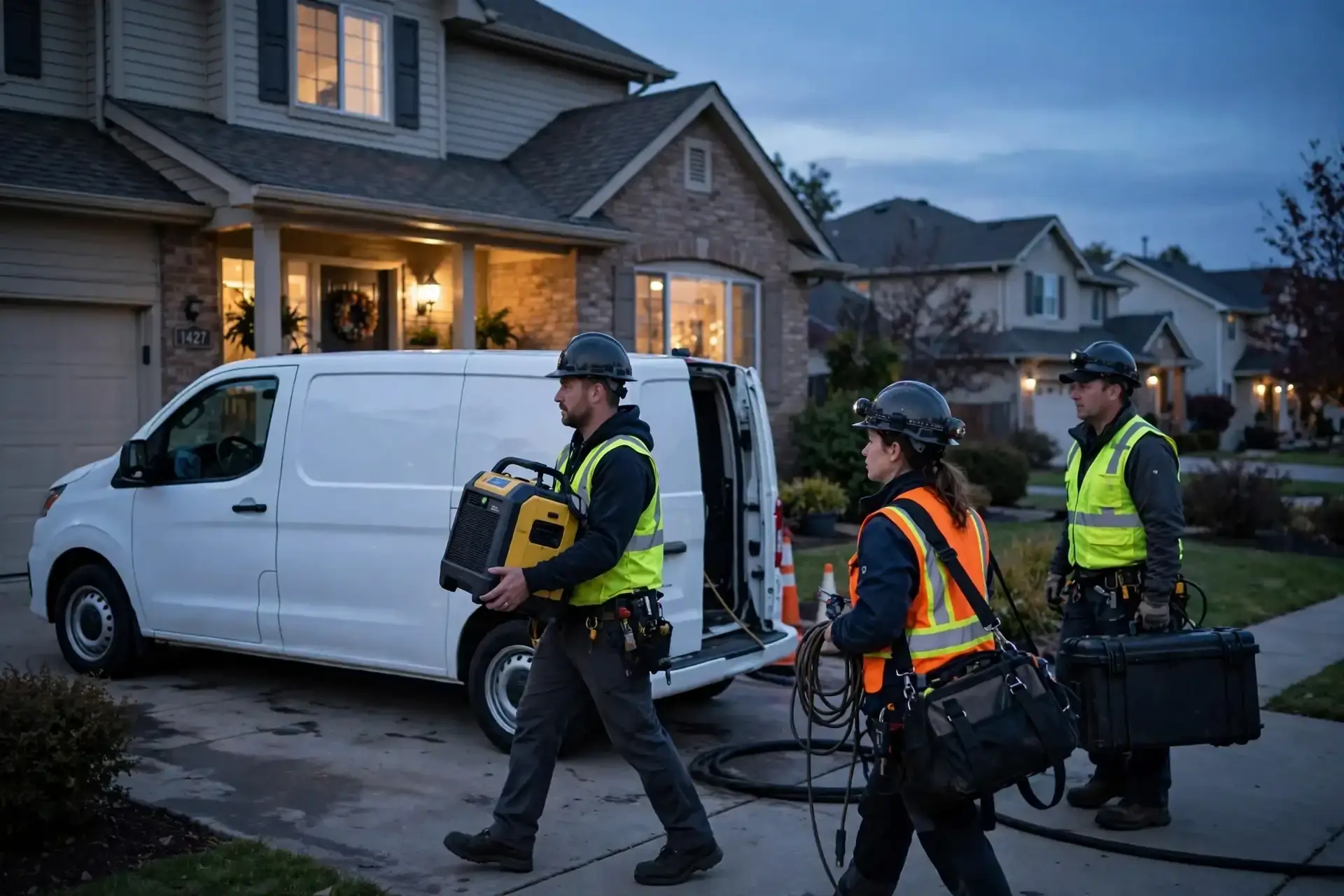
- Equipment on the truck, not a phone estimate. Extraction equipment, air movers, dehumidifiers, and moisture meters should arrive with the crew — mitigation begins on the first visit, not after a quote.
Be wary of companies that promise exact arrival times they can't keep, or that pressure you to sign a work authorization before assessing the damage. A reputable company gets water moving first — but never without your signed approval.
7 Questions to Ask Before You Hire
You don't need to be a restoration expert to vet one. These seven questions separate the professionals from the rest:
- "Are your technicians IICRC-certified, and can you tell me which certifications?" Listen for specific credentials like WRT (Water Damage Restoration Technician) or AMRT (Applied Microbial Remediation Technician) — not just "we're trained."
- "Will you document moisture readings before, during, and after drying?" Professionals measure with meters and infrared cameras and give you readings, not just "it feels dry."
- "Do you provide a written scope of work and itemized estimate?" Verbal promises are worthless in a dispute.
- "How do you handle my insurance claim?" Good companies document damage thoroughly, provide the detailed scope your adjuster needs, and communicate with your carrier — without demanding you sign your claim over to them.
- "Are you insured, and can you show proof?" At minimum: general liability and workers' compensation. If an uninsured crew member is hurt on your property, you could be liable.
- "What happens to materials that can't be dried — do you remove them?" Listen for flood cuts, removal of saturated insulation and carpet pad, and proper disposal.
- "Who does the reconstruction, and is that included?" Clarify where mitigation ends and rebuilding begins, who's doing each phase, and whether permits will be pulled.
Red Flags: When to Walk Away
Storm-chasing operators know Illinois homeowners deal with burst pipes, sump pump failures, and sewer backups. Watch for these warning signs:
- Door-knockers after a storm or cold snap. Reputable restoration companies don't canvas neighborhoods after disasters. Unsolicited door-to-door offers are a classic setup for inflated or phantom work.
- Demands for full payment upfront. Standard practice is a deposit or milestone-based payments, with insurance claims handled through documented invoicing. Anyone demanding everything before touching a tool is a major risk.
- No written scope of work. If a contractor won't put the plan in writing — what gets removed, what gets dried, what gets rebuilt, and for how much — you have no recourse when the result disappoints.
- Pressure to sign over your insurance claim. Some companies ask homeowners to sign an "assignment of benefits," handing the company control of claim proceeds. Be very cautious before signing away your rights.
- No physical Illinois address or local references. Companies that appear only after disasters and vanish after can be impossible to reach when warranty issues arise.
How Insurance Coordination Should Work
Here's how a good claim flows. First, you mitigate: stop the source, document the damage, and get emergency drying started — most policies require reasonable steps to prevent further damage, and delaying mitigation can jeopardize your claim. Then you file: call your carrier promptly and get a claim number. Your restoration company then provides your adjuster with photos, moisture readings, and a detailed written scope. The adjuster reviews it, approves the scope (sometimes with negotiation), and the work proceeds.
Two things to know: standard Illinois homeowners policies generally cover sudden and accidental events like burst pipes or appliance failures, but exclude long-term seepage, neglect, and floodwater unless you carry separate flood insurance. Sewer backup coverage is often an optional rider — worth checking before spring. A company experienced with Illinois claims will know exactly what documentation your adjuster expects.
Still asking yourself who to call for water damage in Illinois? The answer is a local, IICRC-trained company with true 24/7 dispatch and a written process — not a door-knocker, not a handyman. The best time to decide is today, before the emergency: research one company now — IICRC-certified technicians, real 24/7 dispatch, written scopes of work, insurance — and save their number. If that checklist points you to Rapid Water Damage Restoration Illinois, we'd be glad to earn your trust: we serve water damage restoration in Chicago, water damage restoration in Aurora, water damage restoration in Peoria, water damage restoration in Rockford, and water damage restoration in Logan Square. Call Rapid Water Damage Restoration Illinois at (773) 200-3228 any time. We'll answer, we'll show up, and we'll dry your home right.
Frequently Asked Questions
Should I call my insurance company or a restoration company first?
Stop the water and call a restoration company first if water is actively damaging your home — mitigation can't wait for business hours. Call your carrier promptly afterward to open a claim; your restoration company will supply the documentation your adjuster needs.
Is IICRC certification required in Illinois?
No state license or certification is legally required to perform water damage restoration in Illinois. But IICRC certification — based on the ANSI/IICRC S500 standard — is the industry's recognized credential, and adjusters widely expect professional jobs to follow S500 procedures.
How fast should a restoration company respond?
For active water intrusion, you want a crew dispatched within a couple of hours, day or night. During region-wide events like a polar vortex or major storm, honest companies will tell you their current queue instead of making promises they can't keep.
Can a restoration company work directly with my insurance?
Yes — reputable companies document the loss and communicate with your adjuster regularly. What they should not do is pressure you to sign over your claim rights or bill your carrier without keeping you in the loop.
What does it cost to get an estimate?
Most established Illinois restoration companies assess water damage and provide a written scope at no charge, particularly for emergencies.