Published · Last updated · Rapid Water Damage Restoration Illinois
You've found mold — behind the basement drywall, around a leaking window, or spreading across the bathroom ceiling — and the first question everyone asks is the same: what will this cost? The honest answer: any company that quotes a price over the phone without seeing the mold doesn't know what the job involves. Mold remediation cost depends on a handful of concrete factors that can only be evaluated on site. This guide explains each one, so when you get an assessment you'll understand what you're paying for — and why legitimate companies insist on looking before they quote.
Why "Remediation," Not "Removal"
First, a piece of industry honesty that protects you from scams. No reputable company will promise to remove all the mold from your home — because it isn't possible. As the U.S. Environmental Protection Agency states: "There is always a little mold everywhere – in the air and on many surfaces." The industry's own standard, ANSI/IICRC S520 (the Standard for Professional Mold Remediation), similarly states that even following the standard cannot guarantee a mold-free environment, because mold spores are naturally ubiquitous.
So what are you actually paying for? Remediation means returning mold levels to a normal, natural state: removing visible growth, removing the moisture that feeds it, cleaning contaminated materials where possible, and replacing materials where cleaning can't work. The goal is a dry, clean building — not a sterile one. If any contractor promises "complete mold removal" or a mold-free home, that promise itself is the red flag. It's also why the EPA advises spending resources on fixing the moisture problem and cleaning up the mold rather than on expensive testing to identify the mold species.
What Drives Mold Remediation Cost
Five factors determine the scope of a mold job, and all of them can only be evaluated on site.
Cost Factor 1: The Size of the Affected Area
This is the single biggest driver. A small patch of surface mold around a bathroom window is a fundamentally different job than mold spread across basement walls and ceiling joists. Larger areas require more containment materials, more labor hours, more air filtration runtime, and more replacement materials. The square footage also determines how much finished material — drywall, insulation, flooring — must be cut out and replaced, and replacement is often the costliest part of the job.
Cost Factor 2: The Level of Containment Required
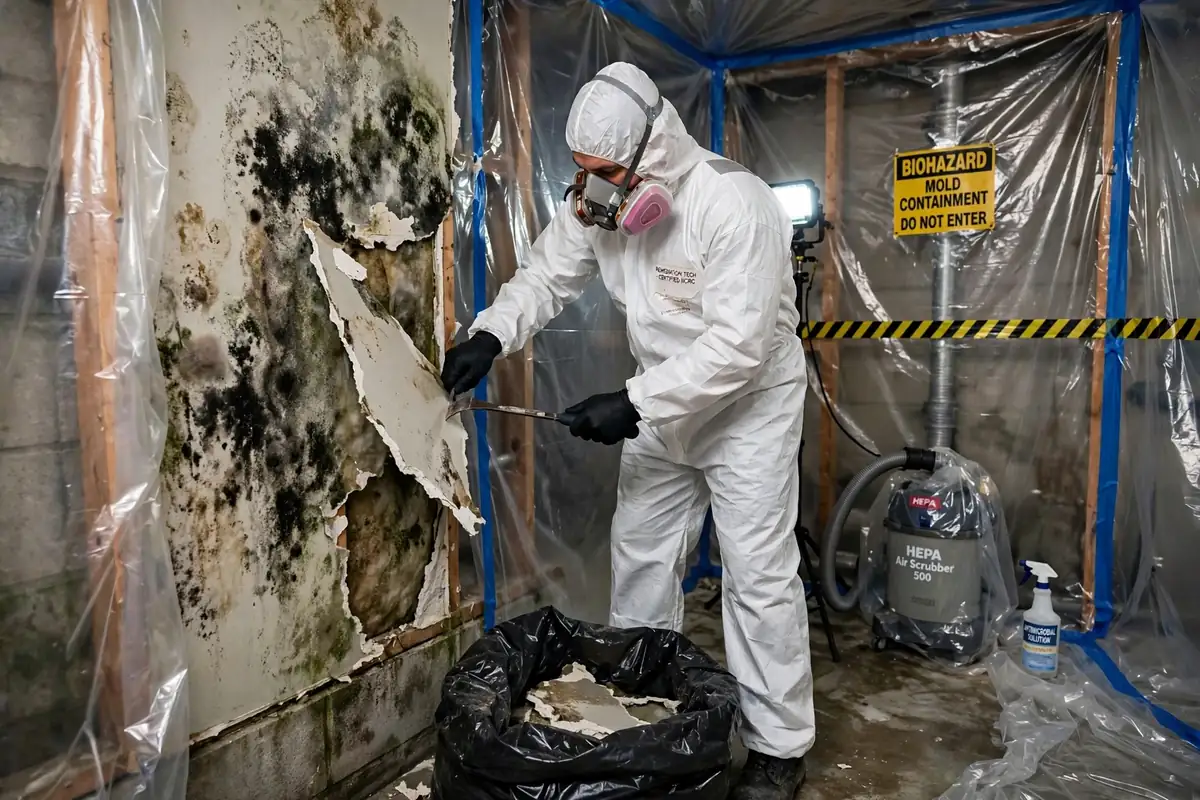
Containment keeps mold spores from spreading to clean parts of your home during the work, and the level scales with the job:
- Limited containment for small, localized areas: poly sheeting sealing off the immediate work zone.
- Full containment for larger areas: floor-to-ceiling barriers, sealed entry points, and negative air pressure maintained by HEPA-filtered air scrubbers so air flows into — not out of — the work zone.
- HVAC protection in all cases: sealing or isolating supply and return registers so ductwork doesn't distribute spores through the house.
Higher containment means more materials, more setup labor, and specialized equipment running throughout the job. When a contractor quotes a bigger job, a significant portion of that increase is containment and air management — not optional extras, but the standard's requirements for doing the work safely.
Cost Factor 3: Material Removal vs. Cleaning
Not every moldy material is handled the same way, and the distinction drives cost. Non-porous surfaces — tile, glass, metal, solid wood — can typically be HEPA-vacuumed and cleaned and stay in place. Semi-porous materials like wood framing can often be cleaned and treated. But porous materials that have absorbed moisture and mold — drywall, ceiling tiles, carpet, insulation, particle board — generally must be removed and replaced, because growth extends into the material where surface cleaning can't reach.
This is why two mold jobs of the same visible size can cost very different amounts. A mold patch on a tile shower surround is mostly a cleaning job. The same-sized patch on a finished basement wall likely means cutting out drywall, pulling wet insulation, and rebuilding the wall. Illinois basements — finished rec rooms and bedrooms below grade — are where this distinction hits hardest, since they're the most common site of hidden mold after spring floods or sump pump failures.
Cost Factor 4: Whether the HVAC System Is Involved
If mold growth has reached your ductwork or air handler — common when a basement floods near the furnace, or when a system has been recirculating musty air — the job gets significantly more complex. Ductwork may require professional cleaning or sealing, air handler components may need remediation, and the system must typically be isolated or shut down during the work to prevent cross-contamination. During your assessment, ask directly: "Has this reached my ductwork, and how will you protect my HVAC system?" Their answer tells you a lot about their thoroughness.
Cost Factor 5: The Moisture Source
Remediation without fixing the moisture source is money wasted — the mold will return. A thorough job includes identifying why the mold grew: a leaking pipe, foundation seepage, poor grading, a failed sump pump, inadequate bathroom ventilation, or condensation from poor insulation. Some fixes are small (re-caulking, adding an exhaust fan); others are substantial (exterior waterproofing, drainage correction). Your quote should clearly separate the mold work from the moisture-source repair. And if your mold followed a spring basement flood, the protection work you do now prevents the next remediation bill later.
What a Legitimate Assessment Looks Like
Reputable companies quote only after an on-site assessment. That visit should include a visual inspection of the affected area and adjacent spaces, moisture meter readings to find hidden wetness, identification of the moisture source, a determination of what can be cleaned versus what must be removed, and a written scope with itemized costs. The work should follow recognized industry practice — for mold, the S520 standard — and technicians should hold IICRC credentials such as AMRT certification. If someone offers a flat price over the phone or pushes you to commit before inspecting, keep looking.
Illinois-Specific Mold Realities
Illinois makes mold a recurring issue rather than a one-time event. Our humid summers keep indoor moisture high, especially in basements without dehumidification. Spring flooding and sewer backups — common in the Chicago area's combined-sewer neighborhoods — soak finished basements and wall cavities that rarely get opened up and dried. Older housing stock, from Chicago bungalows to Rockford colonials, often has limited ventilation by modern standards. Remediation solves today's growth; controlling humidity (below 60 percent indoors), fixing drainage, and maintaining your sump pump prevent tomorrow's.
Frequently Asked Questions
Can I just clean up mold myself?
Small, surface-level mold on hard, non-porous surfaces can often be cleaned by a homeowner following EPA guidance. But mold covering a significant area, mold inside walls or HVAC systems, or mold after a flood or sewage backup calls for professional remediation with proper containment — disturbing large growth without containment spreads spores through the house.
How long does mold remediation take?
A small localized job may take a day or two. Larger jobs involving containment, material removal, drying, and rebuild can run several days to a couple of weeks. The drying phase can't be rushed — rebuilding over materials that aren't verified dry invites recurrence.
Will my homeowners insurance cover mold remediation?
It depends on the cause. If the mold resulted from a covered event — like a burst pipe — remediation is often covered under the water damage portion of the claim, though many Illinois policies have sub-limits for mold. Mold from long-term neglect, seepage, or flooding typically isn't covered.
Do I need mold testing before remediation?
Usually not. The EPA's position is that if visible mold is present, sampling is unnecessary — and no federal standards set "safe" mold levels, so a test result can't certify a building as clean. Resources are better spent on fixing the moisture and removing the growth.
How do I keep mold from coming back?
Fix the moisture source, keep indoor humidity below 60 percent, ventilate bathrooms and kitchens to the exterior, and make sure water drains away from your foundation. In Illinois, that also means maintaining your sump pump and considering a battery backup — power outages during spring storms are a classic setup for a flooded basement and a second round of mold.