Why Drying Matters More Than You Think
Here's the part of water damage most people miss: once the puddles are gone, the job is nowhere near done. Water wicks upward into drywall, soaks through subfloors, saturates the sill plates and studs inside wall cavities, and settles into framing where no fan from a hardware store will ever reach it. A floor can feel dry to the touch while the subfloor beneath it is still holding enough moisture to warp, swell, and feed mold growth for weeks.
This hidden moisture is behind most of the "mystery" problems that show up months after a water event — musty odors that won't go away, hardwood floors that cup or buckle, paint that bubbles on walls that were never visibly wet. Professional structural drying is the difference between a property that truly recovered and one that just looks dry. Our water damage restoration work always includes complete, verified drying — because rebuilding over wet materials is just scheduling your next repair.
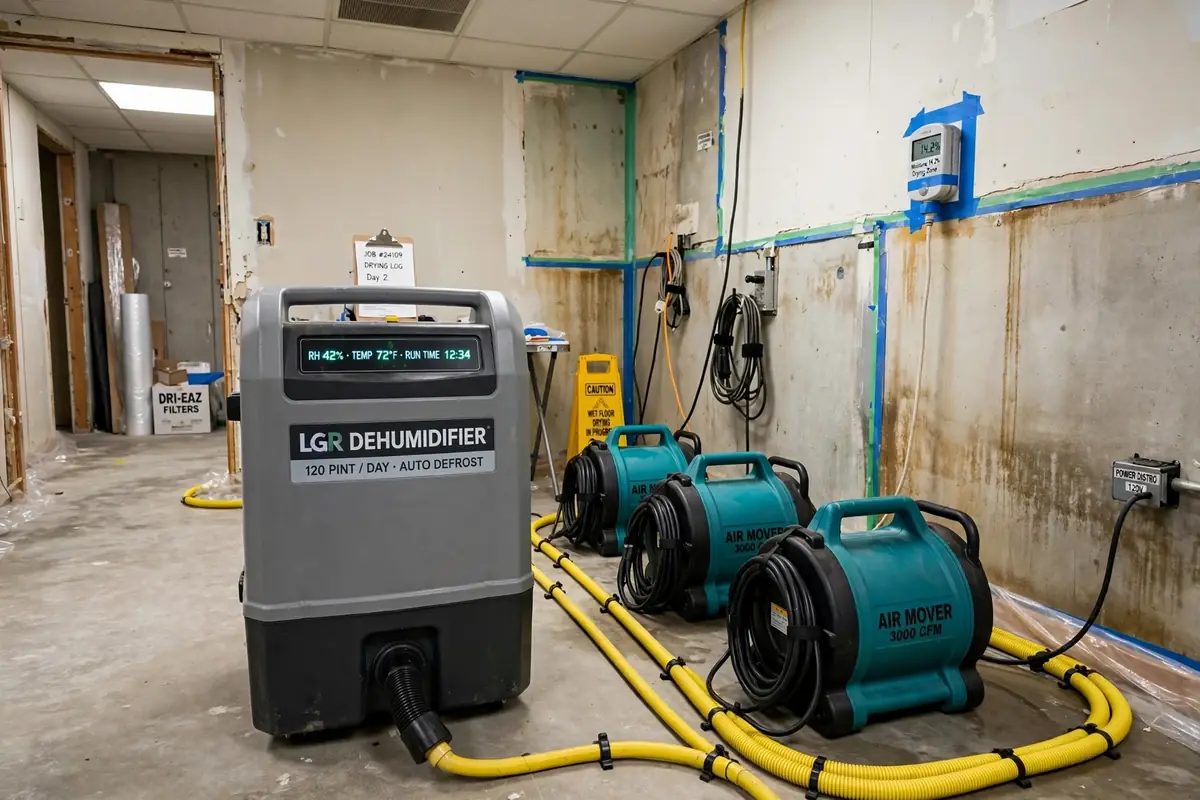
Our Professional Drying Equipment
Proper drying isn't about pointing fans at wet carpet — it's a controlled process using commercial-grade equipment sized and placed for the specific job:
- Truck-mounted extractors. High-powered extraction pulls deep water from carpet, padding, and porous flooring before drying even begins — the more water removed mechanically, the faster everything dries.
- High-velocity air movers. These aren't household fans — they create focused, high-speed airflow across wet surfaces and into wall cavities, constantly replacing the saturated boundary layer of air so evaporation keeps moving.
- Commercial dehumidifiers. Evaporation alone just moves moisture into the air — industrial dehumidifiers pull it out of the air continuously, keeping humidity low enough for drying to proceed. Without them, you're just redistributing the water.
- Moisture meters and thermal imaging. We don't guess where the water went — pin and pinless meters measure moisture inside materials, and thermal cameras reveal wet areas behind surfaces, guiding exactly where equipment goes.
The Drying Process, Step by Step
Every structural drying job follows the same disciplined sequence:
- Step 1 — Moisture mapping. We take readings throughout the affected area and establish drying goals based on dry readings from unaffected materials in your home. This map tells us exactly what needs drying and how we'll know it's done.
- Step 2 — Water extraction. Standing water and deeply saturated materials are extracted first. Every gallon pulled out mechanically is a gallon the dehumidifiers don't have to process.
- Step 3 — Equipment placement. Air movers and dehumidifiers are positioned in a calculated layout based on the moisture map — directed at wet walls, under affected areas, and into cavities — not just scattered around the room.
- Step 4 — Daily monitoring and adjustment. We return daily to take new moisture readings, reposition equipment as drying progresses, and remove any materials that aren't responding. Drying is actively managed, not set-and-forget.
- Step 5 — Verification. Equipment comes out only when moisture readings confirm every affected material has reached its drying goal. Then — and only then — does rebuilding begin.
How We Verify Dryness
"Looks dry" and "feels dry" aren't drying standards — numbers are. Before we start, we take moisture readings from dry, unaffected materials in your property to establish a baseline: the drying goal for everything else. Throughout the job, we log readings from walls, floors, framing, and cavities, tracking progress day by day. Equipment is removed only when the wet materials have returned to those baseline levels — not when the calendar says so, and not when the surface feels okay. This documentation does double duty: it proves the structure is genuinely dry before rebuild, and it gives your insurance adjuster a clear, professional record of the work. If hidden moisture turns up during monitoring — say, a wall cavity that's drying slower than expected — we adjust the approach rather than declaring victory early. Drying you can verify is drying you can trust. For ceiling-specific concerns, see our ceiling water damage repair page.
Structural Drying FAQs
How long does structural drying take?
Most residential drying jobs take three to five days, but it varies with the amount of water, the materials involved, and conditions like temperature and humidity. Dense materials like hardwood and thick framing dry slower than drywall. We monitor daily and remove equipment based on moisture readings, not a fixed schedule.
Can't I just use my own fans and open the windows?
Household fans move air, but they can't generate the focused velocity needed to dry inside wall cavities and subfloors — and without commercial dehumidification, evaporated moisture just stays in the air and re-condenses. In humid Illinois weather, open windows often slow drying rather than help it. Professional equipment and monitoring make the difference.
Why is everything still wet after the standing water is gone?
Because building materials absorb water like a sponge. Drywall, wood framing, subfloors, and insulation hold significant moisture that only releases through controlled evaporation over days. Extraction removes the surface water; structural drying removes the absorbed water.
Do you have to cut out drywall to dry a wall?
Not always. Clean-water damage to drywall can often be dried in place with small ventilation openings behind the baseboard. We remove drywall when it's contaminated, structurally compromised, or won't dry in a reasonable timeframe — and we always explain why before cutting.
How do you know when it's actually dry?
Moisture meters. We compare readings from affected materials against dry baselines from unaffected areas of your property, and we log the numbers daily. Drying is complete when readings confirm the materials have returned to normal levels — verified data, not guesswork.
Dry Means Verified — Not Just "Looks Dry"
Professional structural drying with documented moisture verification across Illinois.
Call (773) 200-3228