Manhattan has roughly quadrupled since 1990 — from 2,205 to 9,387 residents — nearly all of it subdivision rings around a small historic core. Here's the detail that matters for your basement: every one of those subdivision detention ponds is owned and maintained by its HOA. The village's stormwater system is municipal; the ponds that protect your street belong to your neighbors' association. When HOA pond maintenance slips — and it does — a detention pond stops being flood protection and becomes a flood source aimed at the homes around it.
The village's water geography runs on three named creeks — Manhattan Creek (protected under a special village resolution), Jackson Branch, and Prairie Creek — all in the MS4 permit, with segments of Manhattan Creek and Jackson Branch on the impaired-waters list. In April 2013, sanitary "sewer water invasions" hit hard enough that Farmers Insurance named Manhattan a defendant in its 2017 class-action lawsuit. And on June 26, 2018, an EF-1 tornado with 95 mph winds cut a 1.13-mile path through town — a roof-damage-to-water-intrusion vector most homeowners never connect to their next leak.
New subdivision or historic core, your water story is creeks, ditches, and detention ponds. Call (773) 200-3228 — we answer 24/7.
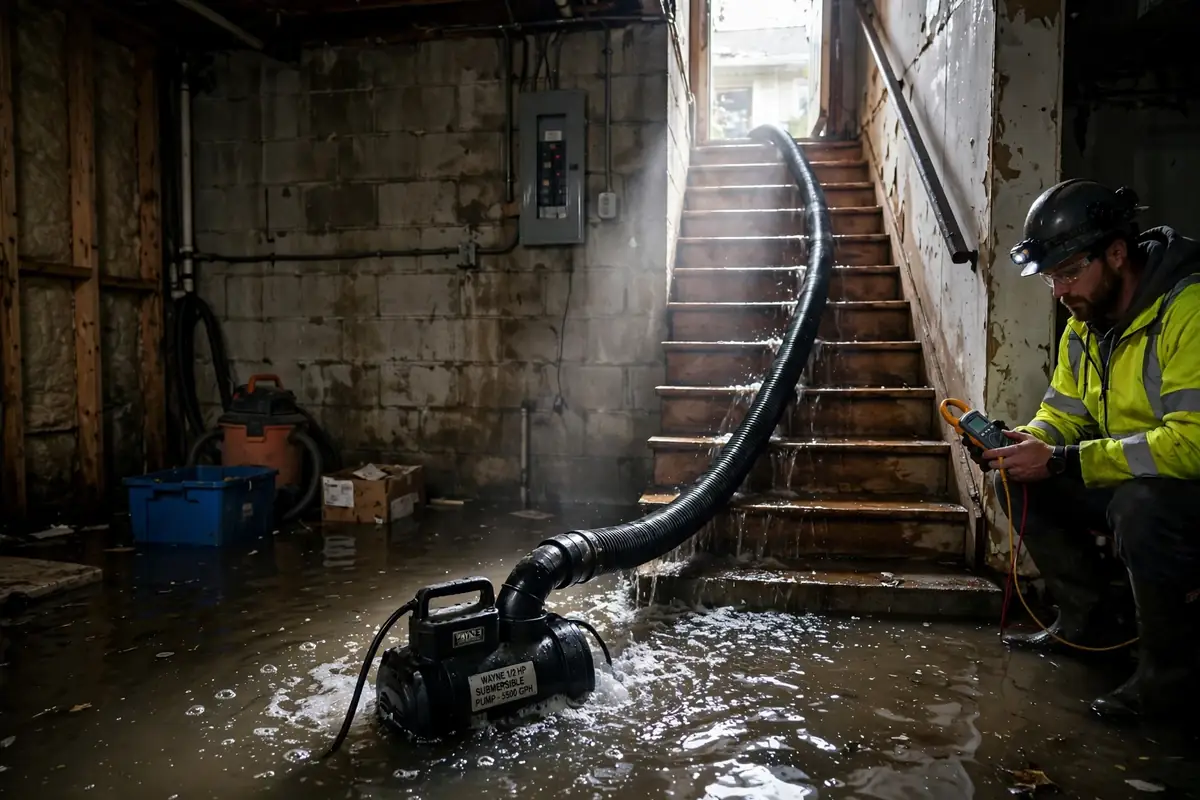
Our Manhattan Water Damage Services
Water extraction
High-capacity pumping for flooded basements and lower levels — from creek-driven seepage to full sanitary surcharge — with containment for contaminated water.
Structural drying
Monitored dehumidification calibrated to your home's generation: the pre-1960 core's plaster and masonry versus the subdivision ring's drywall and engineered lumber — verified with moisture meters.
Mold remediation
IICRC-standard containment, removal, and treatment for mold behind drywall, under flooring, and in wall cavities after backups and creek events.
Sewage cleanup
After sanitary "water invasions": extraction, sanitization, disposal of contaminated porous materials, and disinfection of salvageable surfaces.
Storm damage repair
Repairs for creek flooding, detention-pond overflow, runoff, and wind-driven roof-to-interior water damage — including the 2018 tornado pathway — rebuilt to pre-loss condition.
Common Causes of Water Damage in Manhattan
- HOA-maintained detention ponds. All subdivision detention ponds are owned and maintained by their HOAs — and deferred maintenance (silted inlets, clogged outlets, overgrown embankments) turns a pond into a flood source for the very homes it was built to protect.
- The three creeks. Manhattan Creek, Jackson Branch, and Prairie Creek are the village's receiving waters; flooding here is overbank and ditch-driven rather than riverfront. The July 19–23, 2017 storm stretch dropped heavy rain and wind reports all around town, and village reports document regular ditch cleanups and storm-sewer repairs.
- The April 2013 sanitary invasions. Manhattan was named in the 2017 Farmers lawsuit over April 17–18, 2013 "sewer water invasions" — sewage surcharging up through drains and fixtures. The backup mechanism is I&I-driven sanitary surcharging, not combined outfalls.
- Tornado-driven roof damage. The June 2018 EF-1 tornado (95 mph winds, 1.13-mile path) is a standing reminder: compromised roofs, flashing, and siding let the next storm's water into attics and walls, where it appears as "mystery" ceiling and wall damage months later.
- Vintage laterals in the historic core. The small stock of pre-1940 and mid-century homes along U.S. 52/IL-53 carries vintage lateral and septic-to-sewer transition risk; post-1990 subdivisions trade that for HOA pond risk and clay-soil seepage. The January 2019 polar vortex's rapid thaw cracked mains across the region.
Areas We Serve in Manhattan
We serve all of Manhattan in ZIP 60442, from the historic downtown core on U.S. 52/IL-53 to the 1990s–2000s subdivision rings where HOA ponds define the water story — along the Manhattan Creek corridor, through the Jackson Branch and Prairie Creek drainage areas, and across the blocks bordering New Lenox, Frankfort, and Elwood. We reach you via U.S. 52, IL-53, and I-80.
Cost Factors & Insurance Claim Help
No flat quotes — every Manhattan loss is scoped on its facts: water category (clean supply water versus sewage or creek floodwater), square footage and materials affected, how long they stayed wet, and whether this is a repeat in a pond- or creek-adjacent property. Two coverage questions matter here: your sewer-backup endorsement (the 2013 invasions are the textbook case) and whether storm-driven roof damage falls under wind/hail coverage — the 2018 tornado pathway means some "water damage" is really a roofing claim. We photograph everything, log moisture readings, and work directly with your insurer from first call to final walkthrough.
How We Restore Water-Damaged Homes in Manhattan
- Call (773) 200-3228 — answered around the clock. Sewage backups and active intrusion jump the queue.
- Trace the water to its source: creek overbank, pond overflow, sanitary surcharge, sump failure, lateral breach, or roof-driven intrusion — the source determines both the cleanup protocol and which coverage applies.
- Extract with full containment: standing water out fast; sewage and floodwater events get containment, protective equipment, and disinfection from the first minute.
- Moisture-map, then dry to the meter: hidden moisture in walls, subfloors, attics, and insulation is mapped first, and drying equipment stays until meters confirm every material is dry.
- Sanitize, remove, prevent mold: contaminated materials come out, affected surfaces are cleaned and disinfected, and antimicrobial treatment stops mold before it establishes — essential after repeat creek and pond events.
- Rebuild and document: finishes restored to pre-loss condition; your adjuster gets photos, moisture logs, and a complete event timeline.
Frequently Asked Questions
Who maintains the detention pond behind my subdivision?
Your HOA does. In Manhattan, all subdivision detention ponds are owned and maintained by their homeowners associations — not the village. That makes pond maintenance one of the village's most common stormwater weak points: silted inlets, clogged outlets, and deferred embankment work turn a pond into a flood source. If your street takes water during heavy rain, ask your HOA when the pond was last dredged and its outlets inspected.
What damage did the June 2018 EF-1 tornado do, and what should I check now?
The June 26, 2018 tornado — 95 mph winds on a 1.13-mile path through town — damaged roofs, siding, and trees. For water damage, the legacy is compromised roofing and flashing: the next heavy rain finds the weak spots the tornado created, and water enters attics and walls, appearing as ceiling stains far from the breach. If your home was near the 2018 path and you have unexplained interior water, start with a roof inspection.
What is Manhattan Creek's protected status, and why does it matter to me?
Manhattan Creek is protected under a special village resolution with stricter standards than ordinary stormwater facilities — the village treats it as a higher-value waterway. For homeowners, that means tighter stormwater rules on nearby development. It doesn't make your property flood-proof: segments of Manhattan Creek and Jackson Branch are on the impaired-waters list, and creek-adjacent properties still face overbank risk during heavy-rain stretches like July 2017.
I live in a newer subdivision — why did my basement still take water?
Because "newer" in Manhattan mostly means a post-1990 subdivision ring — and the modern risk profile isn't vintage pipes, it's HOA pond maintenance, clay-soil seepage, and sanitary surcharging. The April 2013 sewer invasions hit plenty of newer homes. Check three things: your HOA's pond maintenance record, your sump and backup-pump setup, and your sewer-backup endorsement. Then call us — the water is already in your walls.
Manhattan quadrupled in size since 1990 — doesn't newer construction mean lower risk?
Lower risk of some things, higher of others. The post-1990 ring (median build year 2005) largely avoids the vintage-lateral and septic-transition problems of the historic core along U.S. 52/IL-53. But it concentrates the modern risks: HOA ponds with uneven maintenance, clay-soil seepage against foundations, and the same I&I-driven surcharging behind the 2017 Farmers lawsuit. Newer doesn't mean drier — it means different.
Water Damage in Manhattan? We Respond 24/7
Every minute counts. Rapid Water Damage Restoration Illinois dispatches certified technicians across Manhattan day and night — with insurance documentation handled for you.
Call (773) 200-3228 NowWater Damage Restoration Services in Manhattan
- Our water damage restoration service
- Commercial Water Damage Restoration in Manhattan
- Residential Water Damage Restoration in Manhattan
- Emergency Flood Cleanup in Manhattan
- Storm & Flood Damage Restoration in Manhattan
- Ceiling & Wall Water Damage Repair in Manhattan
- Sewage Backup Cleanup in Manhattan
- Mold Remediation in Manhattan
- Burst Pipe & Leak Water Damage in Manhattan
- Drying & Dehumidification in Manhattan
Nearby Areas We Serve Around Manhattan
Helpful Water Damage Guides
Official resources: FEMA FloodSmart (flood insurance) and EPA guide to mold and moisture.