North Chicago's water runs east, not west — and that single fact shapes every flood here. Unlike most Lake County suburbs that drain to the Des Plaines, this city's creeks run to Lake Michigan: Dead Dog Creek, Kellogg Creek, Pettibone Creek, the Waukegan River, Bull Creek. And the record books remember them. In 1938, the highest flood on Dead Dog Creek since at least 1900 sent stormwater runoff flooding the veterans hospital here and overwhelmed storm sewers across the corridor — the first well-documented flash-flooding event in Lake County's watershed history. The 1951 flood on the Waukegan River was reported as the highest in the previous 65 years, and the April 1960 snowmelt flood swamped Dead Dog, Kellogg, and Bull Creeks alike.
The city also lives alongside the largest military installation in Illinois. Naval Station Great Lakes — the Navy's only boot camp and largest training station — covers 1,628 acres with some 1,153 buildings, including the 1911 clocktower Building 1 from the original Jarvis Hunt era. And on the civilian side, the Halsey Village story is still unfolding: the 1960s-era, 352-home Navy-family subdivision saw its last residents leave in February 2025, with demolition and environmental remediation underway before the land transfers to the city for mixed-use redevelopment. Older pre-war and postwar bungalows and ranches, apartment corridors along Lewis Avenue and Sheridan Road, ravine-cut lakefront topography — North Chicago's water risks are layered. Rapid Water Damage Restoration Illinois's IICRC-trained technicians are on call 24/7 for all of it. Call (773) 200-3228 anytime, day or night.
Common causes of water damage in North Chicago
- Creek flooding to Lake Michigan. Dead Dog Creek at Sheridan Road, Kellogg Creek, Pettibone Creek, the Waukegan River, Bull Creek — the 1938, 1951, and 1960 events all ran through these channels, and the July 2017 flash floods and the May 14, 2018 warning (which explicitly named North Chicago) hit the same corridor.
- Storm-sewer overwhelm. The 1938 flood's lesson stands: when runoff exceeds the system, storm sewers back up and localized flooding follows. Bluff-and-ravine topography along the lakefront funnels water fast toward low spots.
- Sewer backup in extreme rain. Separated systems still surcharge in a deluge; the regional July 2017 pattern — water rising through basement drains as blackwater — is the pathway to know.
- Older and underheated housing stock. Pre-war and postwar bungalows, ranches, and small single-family homes near the base carry aging supply lines and full basements, and vacant or distressed properties — the Halsey Village legacy — are the classic underheated frozen-pipe profile.
- Polar-vortex freeze damage. January 2019's −23°F at O'Hare and the brutal 2013–14 winter produced thousands of frozen services region-wide. In older homes with marginal insulation, pipes in exterior walls and crawl spaces are the first to go.
Our North Chicago water damage services
Emergency water extraction:
Creek floodwater, storm-sewer backup, burst pipes — truck-mounted and portable extractors clear standing water fast.
Structural drying and dehumidification:
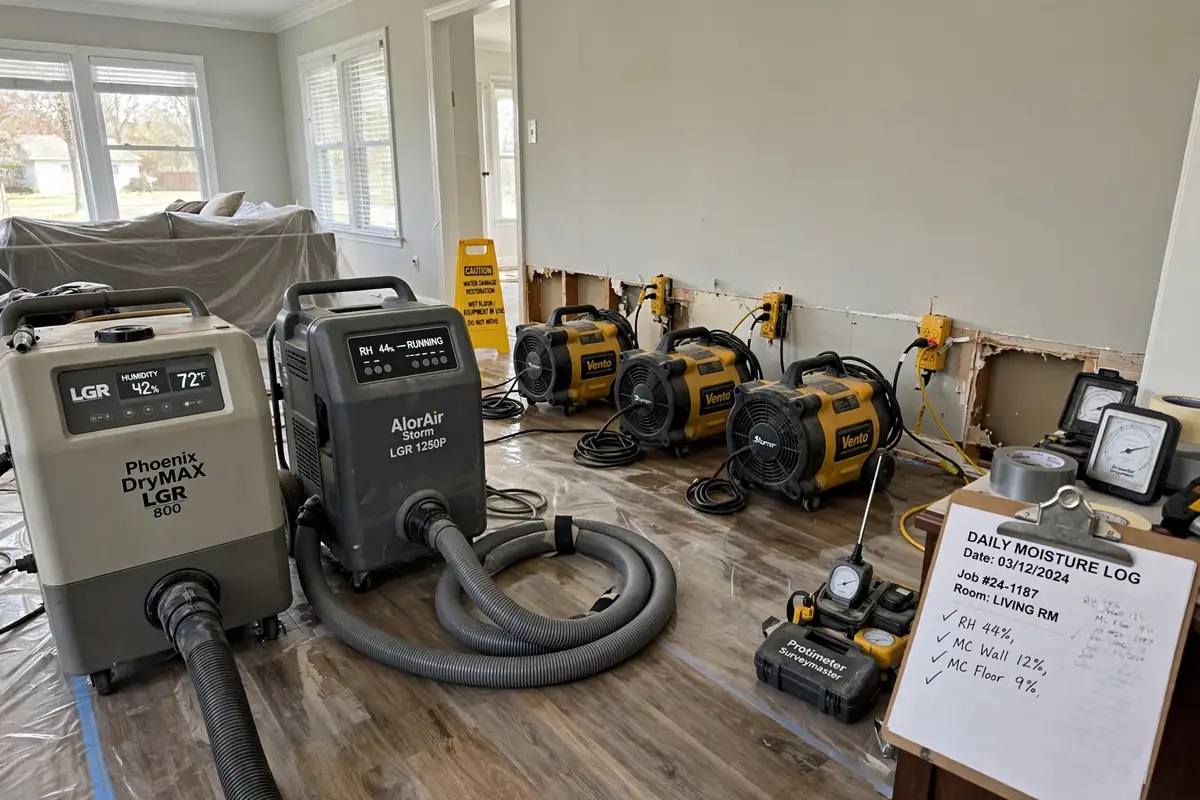
Industrial air movers and low-grain dehumidifiers, verified with moisture meters — older plaster-and-lath interiors and wood framing need deep, measured drying.
Mold remediation:
Damp basements in pre-war homes are mold-prone. We isolate the affected area, pull out contaminated materials, and apply IICRC-standard treatment.
Sewage cleanup:
Water entering through drains is Category 3. Full containment, disinfection, and safe disposal — with the source pathway documented for your claim.
Storm response:
From a creek flash flood to a January burst pipe, we stabilize, extract, dry, and coordinate repairs.
Areas we serve in North Chicago
We cover all of North Chicago — ZIP 60064, plus the unique 60086 and the Great Lakes Naval Station 60088 — including Halsey Village, the Foss Park area, the Greenbelt Cultural Center area, downtown along Sheridan Road (IL-137), the naval base corridor, and Nunn Beach on the lakefront. We're minutes from the Lovell Federal Health Care Center, Foss Park District (founded 1907), and the Metra stations at North Chicago and Great Lakes.
How We Restore Water-Damaged Homes in North Chicago
- Call (773) 200-3228 anytime. A crew dispatches 24/7 to 60064. First on site, we identify the water's category — creek floodwater and sewer backup are contaminated — and trace how it entered.
- Extract the water. Commercial pumps and extractors remove standing water within hours of your call; with contaminated water, speed limits how deep it penetrates.
- Map and dry. We meter walls, floors, and framing, then run air movers and dehumidifiers until readings confirm materials are genuinely dry.
- Disinfect and remediate. Affected surfaces are disinfected; mold growth is contained, removed, and treated to IICRC standards.
- Rebuild and close out. Damaged drywall, flooring, and finishes are restored to pre-loss condition, with photos, moisture logs, and itemized records for your insurer.
North Chicago water damage FAQs
What is Dead Dog Creek, and where does it flood? Dead Dog Creek — also documented as the "Lake Michigan Tributary" — crosses North Chicago at Sheridan Road. It is the creek behind the city's signature flood: the 1938 event, the highest on the creek since at least 1900, when stormwater runoff flooded the veterans hospital and overwhelmed storm sewers in the corridor. It flooded again in the April 1960 snowmelt event.
The veterans hospital flooded in 1938 — where is it? That was the naval hospital/VA campus — today's Captain James A. Lovell Federal Health Care Center. The 1938 flood on Dead Dog Creek sent stormwater runoff into the facility, a measure of how high that water ran. If you live near the creek corridors today, that history is your benchmark.
What is happening at Halsey Village? Halsey Village was a 90-acre, 352-home Navy-family subdivision built in the 1960s. By 2024 roughly three-quarters of its homes were uninhabitable; the last residents left in February 2025. The Navy is now demolishing and remediating the site before transferring it to the City of North Chicago for mixed-use redevelopment — one of the largest land-use turnovers on the North Shore.
How do the lakefront bluffs and ravines move stormwater? North Chicago's Lake Michigan watershed topography includes bluffs and ravines along the lakefront. Ravines are natural water highways — they concentrate runoff and route it fast toward the lake, which is why properties near ravine corridors can see sudden water movement during heavy rain even when the creeks themselves haven't crested.
Which ZIP is mine — 60064, 60086, or 60088? Most of the city is 60064. The 60086 ZIP is unique to North Chicago, and 60088 belongs to the Great Lakes Naval Station. Tell us your ZIP when you call and we'll confirm coverage — we serve all three.
Cost factors & insurance claim help
Every job is priced on its own facts: water volume and spread, contamination category, duration before extraction, and how much material must be removed and rebuilt. Older homes can add complexity — plaster, original framing, aging laterals — that we account for honestly in the estimate. We document source, category, and entry pathway precisely, because creek floodwater, storm-sewer backup, and supply-line breaks are treated differently by most policies. We run point with your insurance company from the first call all the way to the final walkthrough.
Water Damage in North Chicago? We Respond 24/7
Every minute counts. Rapid Water Damage Restoration Illinois dispatches certified technicians across North Chicago day and night — with insurance documentation handled for you.
Call (773) 200-3228 NowWater Damage Restoration Services in North Chicago
- Our water damage restoration service
- Commercial Water Damage Restoration in North Chicago
- Residential Water Damage Restoration in North Chicago
- Emergency Flood Cleanup in North Chicago
- Storm & Flood Damage Restoration in North Chicago
- Ceiling & Wall Water Damage Repair in North Chicago
- Sewage Backup Cleanup in North Chicago
- Mold Remediation in North Chicago
- Burst Pipe & Leak Water Damage in North Chicago
- Drying & Dehumidification in North Chicago
Nearby Areas We Serve Around North Chicago
Helpful Water Damage Guides
- Spring Flooding in Illinois: Home Protection Guide
- Water Damage Restoration Cost in Illinois: What Really Drives the Bill
Official resources: FEMA FloodSmart (flood insurance) and EPA guide to mold and moisture.