Riverside is no ordinary suburb. In 1869, Frederick Law Olmsted and Calvert Vaux laid out this village as one of America's first planned communities — winding curvilinear streets, park-like lots, even historic gas street lighting — and nearly the whole village was designated a National Historic Landmark district in 1970 (expanded in 2023). Roughly 9,000 residents live among homes by Frank Lloyd Wright (the F. F. Tomek House and Coonley House are individual National Historic Landmarks), Daniel Burnham, Louis Sullivan, William Le Baron Jenney, and Vaux himself. It's a village built around the Des Plaines River — and it has always paid the river's price.
The river bounds Riverside's east and south, and the Cook County hazard plan quotes the village plainly: "We experience flooding from the Des Plaines River on a regular basis," striking residential and multifamily structures, 1st Avenue, and Riverside Brookfield High School. The record book is grim reading. The Riverside gage crested at 8.8 feet in the October 1986 flood; September 2008 brought the second-highest crest ever at 9.86 feet; then April 17–18, 2013 delivered the highest recorded crest of all, sending Governor Pat Quinn to survey the damage on April 22 and drawing 50 Riverside households into the post-flood survey. The Groveland Levee protecting a large residential area east of the river has breached repeatedly, and the village is pursuing an expanded levee and floodwall. As recently as fall 2026, the National Weather Service was issuing flood warnings for the Riverside gage at 7.1 feet — uncomfortably near the 7.5-foot flood stage.
Below the streets, Riverside runs on a combined sewer system, per the village's own CSO manual. During heavy rain the village reposts MWRD overflow action alerts urging residents to limit water use — because overloaded combined sewers can back sewage into streets and basements. In Riverside, a bad storm can hit from above and below at once. Rapid Water Damage Restoration Illinois answers 24/7. Call (773) 200-3228.
Common Causes of Water Damage in Riverside
- Des Plaines River overbank flooding. The river is the village's eastern and southern edge; regular flooding hits homes, multifamily buildings, 1st Avenue, and the high school corridor.
- Groveland Levee breaches. The levee protecting the large residential area east of the river has failed repeatedly — the village's own plan flags it as a standing vulnerability.
- Combined-sewer backup. One pipe carries sanitary waste and stormwater; in heavy rain the system surcharges and pushes sewage through basement floor drains and low fixtures.
- CSO discharge corridors. The village's CSO manual identifies discharge points to the river at the 31st Street bridge, Barrypoint Bridge, Riverside Road near Gage, and the Ogden Avenue bridge.
- Century-old plumbing. Many Riverside homes are 100+ years old with original service lines — galvanized and copper runs that crack, clog, and burst in hard freezes.
- Frozen ground, fast runoff. The February 2018 flood warning noted frozen ground producing rapid runoff — a signature late-winter hazard in this river corridor.
- Salt Creek exposure. The village's southeast edge near Forbes Road borders Salt Creek, adding a second waterway for nearby properties.
Our Water Damage Services in Riverside
Emergency water extraction
River floodwater, combined-sewer backup, sump pump failures, burst lines — truck-mounted extraction with containment for contaminated water, day or night.
Structural drying for historic construction
Wright-era and Olmsted-era homes need metered drying for plaster, old-growth millwork, and masonry — verified with instruments, never rushed.
Mold remediation
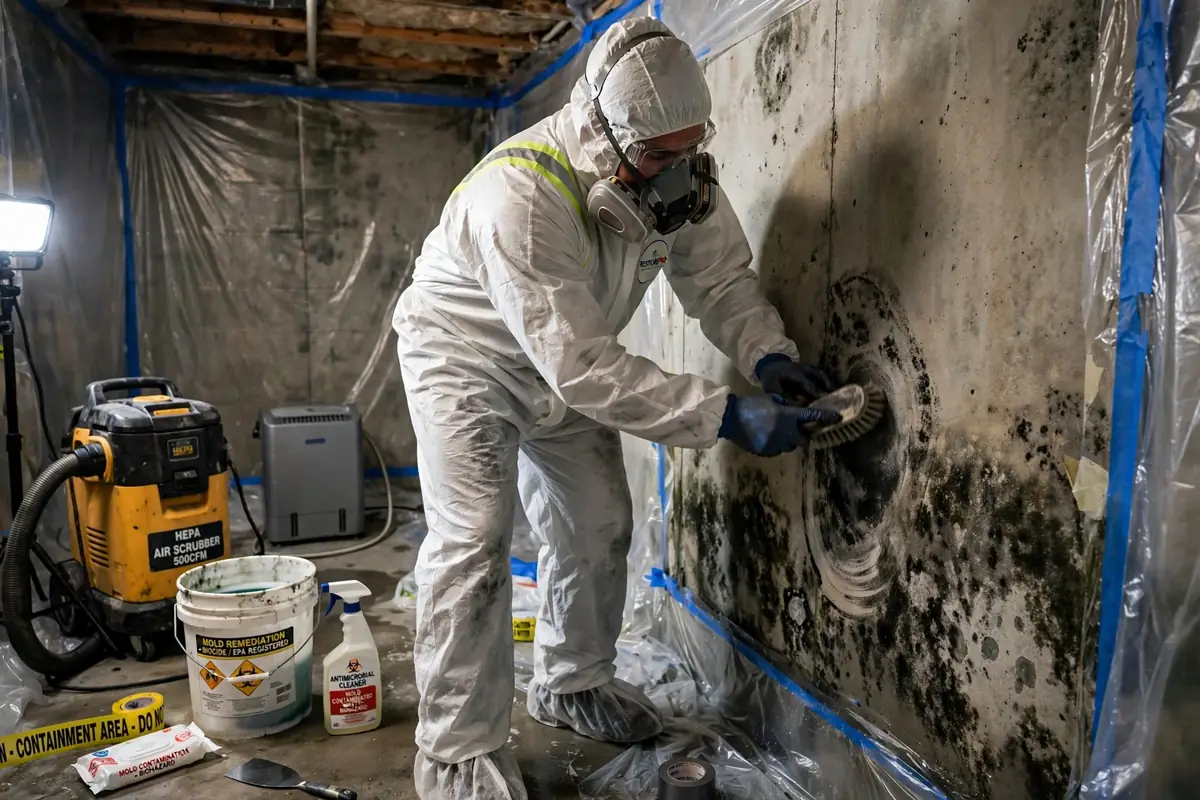
Water in wall cavities and under historic finishes grows mold within days. We contain, remove, and treat to IICRC standards with full documentation.
Sewage cleanup
Combined-sewer backups are Category 3 contamination: sanitization, safe disposal of unsalvageable porous materials, and verification before rebuild.
Storm damage restoration
Flood-damaged interiors are repaired to match original character — period plaster, woodwork, and finishes — with photographic records for insurance.
Areas We Serve in Riverside
We respond throughout ZIP 60546 — bounded by 26th Street, Harlem and Ogden Avenues, the Des Plaines River, and Forbes Road. That includes the large residential area east of the river behind the Groveland Levee, homes along the river corridor, the blocks around Swan Pond and the Olmsted park system, the historic rail-station village center and the Riverside Arcade, the Riverside Water Tower neighborhood, and homes near Riverside Brookfield High School.
How We Restore Water-Damaged Homes in Riverside
- Call (773) 200-3228, any hour. We roll with extraction equipment, prioritizing active flooding and sewage backups.
- Find the source. River overbank, combined-sewer surcharge, failed sump, or burst century-old pipe — the source determines the protocol and the paperwork.
- Extract and contain. Standing water is removed fast; sewage and river water get containment barriers and protective protocols first.
- Track hidden moisture. Meters and thermal imaging locate water inside plaster walls, under wood floors, and behind millwork — where vintage Riverside homes hide it.
- Dry to measured targets. Air movers and dehumidifiers run on a monitored schedule, with daily readings logged until every material verifies dry.
- Restore and document. Repairs match original character; everything is photographed and logged for your insurance file from day one.
Cost Factors & Insurance Claim Help
No flat quotes — every Riverside loss is scoped on its facts. Cost tracks the water category (sewage and river water cost more than clean supply water), the square footage and materials affected, how long they stayed wet, and the caliber of finishes. Period plaster dries slower than drywall, and matching Wright-era woodwork and millwork is skilled work. Coverage often hinges on a sewer-backup endorsement or a flood-versus-sewer distinction, so we review your policy with you before the adjuster visit. We build the file your insurer needs — detailed photo logs, moisture readings, line-item scopes — and work directly with your insurance company from the first call to the final walkthrough.
Frequently Asked Questions
Why does the village ask residents to limit water use during storms?
Because Riverside's sewers are combined — one pipe carries both sanitary waste and stormwater. When heavy rain overloads the system, anything more sent down drains can come back up through basement floor drains. The village reposts MWRD overflow action alerts with that warning. Holding off laundry, dishwashing, and showers during the worst of a storm genuinely reduces backup risk.
What is the Groveland Levee, and does it protect my street?
The Groveland Levee protects a large residential area east of the Des Plaines River — the most flood-exposed neighborhood in the village. But the Cook County hazard plan notes the levee has experienced repetitive breaches, and the village plans to expand, extend, and raise it along with a new floodwall. Levee-side living means elevated protection, not guaranteed protection — know your elevation and keep a restoration number ready.
The 2013 flood was the highest crest ever recorded. What changed after it?
The April 2013 flood — the highest recorded crest at the Riverside gage — prompted the village to pursue a floodwall east of the river and levee improvements, and it drew the Governor's visit on April 22, 2013. But later events kept coming: a February 2018 flood warning, and NWS flood warnings still arriving in fall 2026. Mitigation has reduced risk; it hasn't retired the river.
My home is in the National Historic Landmark district. Does restoration work differently?
The emergency work is the same — extraction and drying come first, always. The difference is in the rebuild: Riverside's landmark homes demand period-appropriate finishes — plaster repaired rather than ripped out, original millwork matched, masonry preserved. We photograph everything before removal, which supports both careful restoration and your insurance claim.
How do the MWRD overflow alerts affect my basement?
When you see the village repost a Metropolitan Water Reclamation District overflow action alert, it means combined sewers are near or at capacity. That's when backups through floor drains and laundry sinks are most likely. It's your cue to stop using water, check that your sump is running, and watch basement drains — and to call (773) 200-3228 at the first sign of trouble.
Water Damage in Riverside? We Respond 24/7
Every minute counts. Rapid Water Damage Restoration Illinois dispatches certified technicians across Riverside day and night — with insurance documentation handled for you.
Call (773) 200-3228 NowWater Damage Restoration Services in Riverside
- Our water damage restoration service
- Commercial Water Damage Restoration in Riverside
- Residential Water Damage Restoration in Riverside
- Emergency Flood Cleanup in Riverside
- Storm & Flood Damage Restoration in Riverside
- Ceiling & Wall Water Damage Repair in Riverside
- Sewage Backup Cleanup in Riverside
- Mold Remediation in Riverside
- Burst Pipe & Leak Water Damage in Riverside
- Drying & Dehumidification in Riverside
Nearby Areas We Serve Around Riverside
Helpful Water Damage Guides
Official resources: FEMA FloodSmart (flood insurance) and EPA guide to mold and moisture.