On April 18–19, 2013, Deerfield's Public Works crews watched both rivers rise at once. The Village issued official Storm Updates as the West Fork and the Middle Fork of the Chicago River climbed — stormwater overflowed into the village's reservoirs, filling them to roughly three-quarters capacity, and streets closed until only Woodvale Avenue between Oxford and Warrington Road remained shut. The village distributed sandbags from the Public Works Facility at 465 Elm Street and published official basement flood-cleanup guidance: pump out standing water, scrub with detergent, run fans and dehumidifiers, and contact a flood restoration company.
Regionally, April 2013 pushed Chicago's April rainfall to a record 8.54 inches, and the governor declared a state of emergency. In Deerfield, the lesson was about holding water back — a system of reservoirs and detention basins that Public Works monitors closely, including a Park Storm Water Retention Pond that crews actively pump down ahead of incoming storms.
Deerfield's 1950s–60s ranches and split-levels sit on full basements with furnaces, water heaters, and laundry below grade, so a few inches of fork-river floodwater or a burst pipe does serious damage. Our IICRC-trained technicians are ready 24/7 — call (773) 200-3228 anytime, day or night.
Our Deerfield water damage services
Water extraction:
Truck-mounted and portable extractors clear fork-river floodwater, reservoir-overflow ponding, and surcharged basements — fast.
Structural drying and dehumidification:
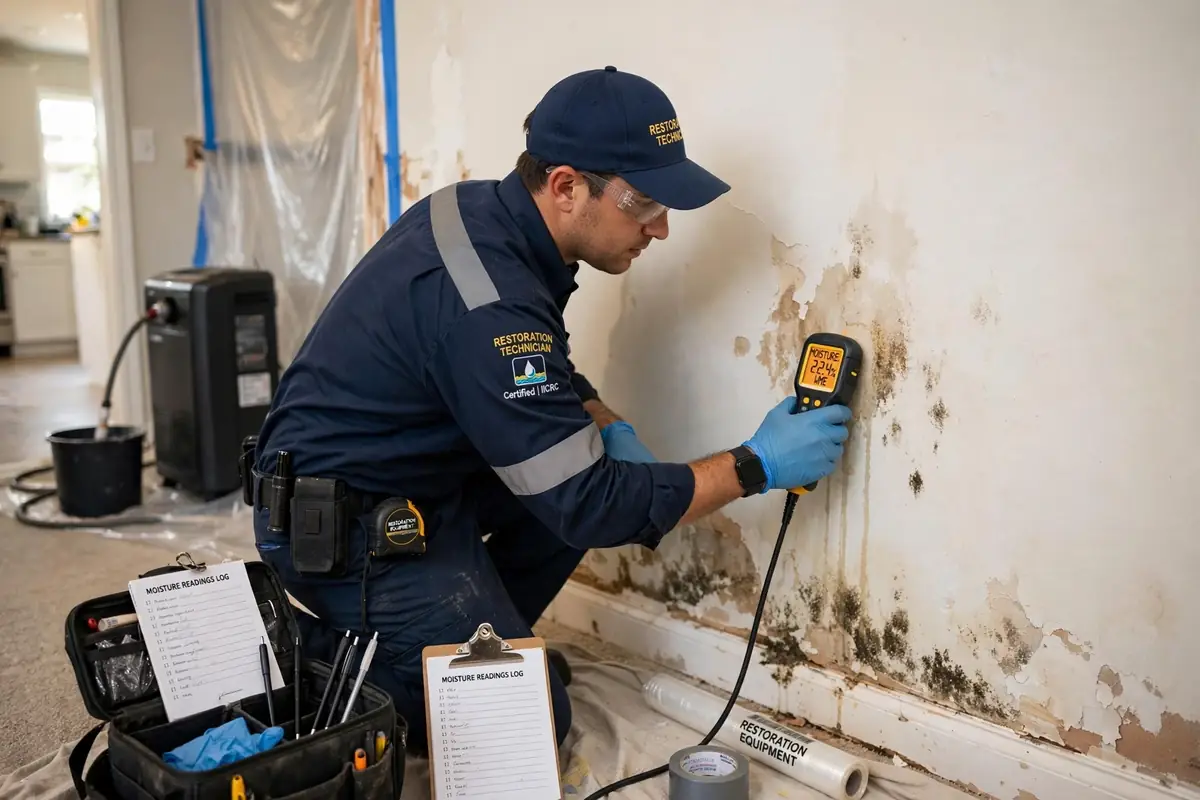
Industrial air movers and low-grain dehumidifiers run until moisture meters confirm dryness — essential for 1950s ranch basements where moisture lingers in framing and subfloors.
Mold remediation:
within days, flood-soaked drywall, carpet, and insulation start growing mold. We seal off the area, remove contaminated materials, and treat to IICRC standards.
Sewage cleanup:
Floodwater entering through drains and plumbing is Category 3. We set full containment, disinfect everything affected, remove what can't be saved — and log the source pathway for your claim file.
Storm response:
From West Fork and Middle Fork high water to a February burst pipe in a split-level, we stabilize, extract, dry, and coordinate repairs.
Areas we serve in Deerfield
We cover all of Deerfield — ZIP 60015 — including North Trail, Deer Run, Northeast Deerfield, Leclair Estates, the Jaycee Park area, downtown Deerfield and the Metra station, the Deerfield High School area, and the village's reservoir and detention park system.
Common causes of water damage in Deerfield
- West Fork and Middle Fork flooding. Both branches of the Chicago River run through Deerfield; in April 2013, stormwater overflowed into the village's reservoirs and nearly filled them — low-lying basements near the forks take water first.
- Overwhelmed detention and stormwater systems. Deerfield depends on reservoirs and detention basins to buffer big storms; when the system fills to three-quarters or more, surrounding ground saturates and basements seep.
- Full-basement housing stock. The village's 1950s–60s ranches and split-levels sit on full basements with mechanicals below grade — so the same few inches of water that would only wet a crawlspace destroys furnaces and finished space here.
- Aging service lines and supply plumbing. Mid-century homes carry older plumbing in exterior walls and crawl spaces — the classic burst-pipe exposure during polar-vortex cold snaps like January 2014 and January 2019. University of Illinois Extension notes a crack just 1/8 inch wide can release up to 250 gallons of water per day into a home.
- Teardown and infill construction. Active new-construction infill (like Leclair Estates) changes local drainage patterns; regrading near older homes can redirect runoff toward foundations.
How We Restore Water-Damaged Homes in Deerfield
- Stabilize. The crew arrives with extraction gear, shuts down electrical hazards, and stops active intrusion — whether that's river water at the door or a burst pipe upstairs.
- Extract. Commercial pumps and truck-mounted extractors remove standing water fast; in a ranch or split-level with a full basement, speed is what saves the lower level.
- Dry, clean, and protect. Air movers and dehumidifiers pull moisture from framing and finishes while contaminated areas are disinfected and salvageable contents are cleaned, documented, and stored safely.
- Restore and document. Damaged materials are repaired or replaced, and the claim file — photos, moisture logs, itemized scope — goes to your insurer so the paperwork keeps pace with the work.
Cost factors & insurance claim help
Cost hinges on water volume, how far it spread, the water category (clean supply-line water versus contaminated river or sewage water), and how much finished material — drywall, flooring, cabinetry — must be removed and rebuilt. Because Deerfield losses so often involve fork-river flooding or plumbing failure in mid-century basements, the source-and-pathway question drives coverage — and we document it precisely. You get an itemized scope before work proceeds.
Deerfield water damage FAQs
What happened in Deerfield in April 2013? On April 18–19, 2013, the West Fork and Middle Fork of the Chicago River rose sharply. Stormwater overflowed into the village's reservoirs — filling them to about three-quarters — all village streets were eventually reopened except Woodvale Avenue between Oxford and Warrington Road, and sandbags were distributed at the Public Works Facility at 465 Elm Street.
How does Deerfield's reservoir system protect my home? The village relies on a network of reservoirs and detention basins that Public Works actively monitors — including a Park Storm Water Retention Pond that crews pump down ahead of incoming storms to free up capacity. When the system nears full, surrounding ground saturates and basement seepage risk rises sharply.
What cleanup guidance did the village publish after the 2013 flood? Deerfield's official guidance told residents to pump out standing water, scrub surfaces with detergent, run fans and dehumidifiers, and contact a flood restoration company. We follow that same sequence professionally — with commercial extraction and meter-verified drying instead of box fans and guesswork.
Where does the village distribute sandbags during floods? In April 2013, sandbags were available at the Public Works Facility, 465 Elm Street, Deerfield, IL 60015. Watch village storm updates during fork-river high water for current distribution points.
Why are Deerfield's ranch and split-level homes at extra risk? Most were built in the 1950s–60s with full basements — finished or unfinished — holding furnaces, water heaters, and laundry below grade. Older service lines and supply plumbing in exterior walls and crawl spaces also make them the classic burst-pipe exposure during polar-vortex cold snaps.
Water Damage in Deerfield? We Respond 24/7
Every minute counts. Rapid Water Damage Restoration Illinois dispatches certified technicians across Deerfield day and night — with insurance documentation handled for you.
Call (773) 200-3228 NowWater Damage Restoration Services in Deerfield
- Our water damage restoration service
- Commercial Water Damage Restoration in Deerfield
- Residential Water Damage Restoration in Deerfield
- Emergency Flood Cleanup in Deerfield
- Storm & Flood Damage Restoration in Deerfield
- Ceiling & Wall Water Damage Repair in Deerfield
- Sewage Backup Cleanup in Deerfield
- Mold Remediation in Deerfield
- Burst Pipe & Leak Water Damage in Deerfield
- Drying & Dehumidification in Deerfield
Nearby Areas We Serve Around Deerfield
Helpful Water Damage Guides
- What to Do When Your Basement Floods: A Step-by-Step Emergency Guide
- Spring Flooding in Illinois: Home Protection Guide
Official resources: FEMA FloodSmart (flood insurance) and EPA guide to mold and moisture.