The Village of Buffalo Grove has named its enemy in writing. In its 2023 Repetitive Loss Area letter, the village said it had "initiated the Buffalo Creek Study with the adjacent Village of Wheeling in order to explore mitigation opportunities for the #1 source of flooding within the community of Buffalo Grove" — and that source is Buffalo Creek. The creek drains a 27-square-mile watershed, gathers in the Buffalo Creek Reservoir at Buffalo Creek Forest Preserve, and discharges into the Des Plaines River near Wheeling. The MWRD–Lake County Forest Preserve District–village reservoir partnership dates to 1973, and an expansion added 58.6 million gallons of storage. The Des Plaines watershed has still delivered regional floods in 2004, 2007, 2008, 2013 — and July 2017 brought record floods, a Lake County disaster proclamation, and roughly 6,800 impacted buildings north of Chicago, "worse than the damage in 2013." When Buffalo Creek rises, a 1958-era pipe lets go, or a storm overwhelms the system, Rapid Water Damage Restoration Illinois answers 24/7 across Buffalo Grove. Call (773) 200-3228.
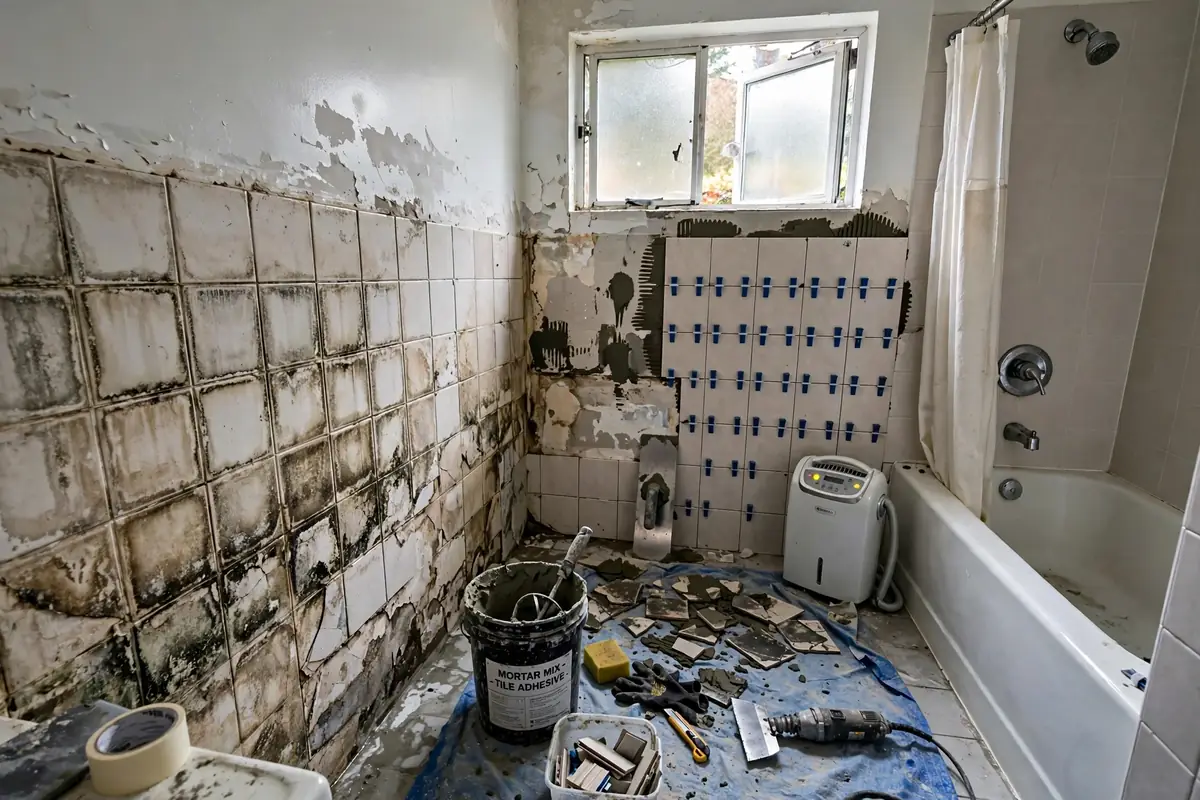
Our Buffalo Grove water damage services
Water extraction
Buffalo Creek overbank, tributary runoff, system-overload flooding, and burst pipes — high-capacity pumping for watershed events and neighborhood-level failures alike.
Structural drying
Monitored dehumidification for 1960s–70s ranch, split-level, and colonial homes, 1980s–2000s infill, and Lake Cook Road corridor condos — metered daily until every material reads dry.
Mold remediation
IICRC-standard containment, removal, and treatment where creek flooding, sump issues, or hidden pipe leaks leave moisture in basements, wall cavities, and crawl spaces.
Sewage cleanup
Even in a separated-sewer village, stormwater inflow can surcharge the sanitary system; we extract category-3 water in full PPE, remove contaminated materials, and disinfect every affected surface.
Storm damage repair
Wind- and hail-opened roofing, siding, and windows are secured; interior water intrusion is extracted, dried, and rebuilt to pre-loss condition.
Common causes of water damage in Buffalo Grove
- Buffalo Creek. It is the village-documented #1 flood source — a 27-square-mile watershed feeding through the Buffalo Creek Reservoir and into the Des Plaines River. When the creek surges, low-lying homes and streets along its corridor take water first.
- Regional Des Plaines watershed floods. The Corps of Engineers' Upper Des Plaines study names the regional events: 2004, 2007, 2008, 2013. July 2017 set new records on the Des Plaines and North Branch Chicago Rivers — a Lake County disaster proclamation for a flood that impacted roughly 6,800 buildings, worse than 2013.
- The reservoir's limits. The MWRD–LCFPD–village partnership has held since 1973 — the MWRD's original reservoir stores 720 acre-feet, and the expansion added 58.6 million gallons — but storage buys time, not immunity, against record watershed events like July 2017.
- First-generation infrastructure. The village's 2020 Infrastructure Modernization Program was created because "first-generation water and sanitary" infrastructure deficiencies exist in the Cook County portions of the village — the oldest 1958–1970s subdivisions carry the oldest pipes and the highest winter-break risk. Over $175 million in capital projects were planned village-wide.
- Sump-pump realities. The village maintains 136 miles of sanitary sewer and 12 sanitary lift stations — and it is illegal to connect a sump pump to a sanitary sewer. A sump discharging next to the foundation, or a failed pump in a 1960s ranch, turns a storm into a basement flood.
- A 1958-boom housing stock. First housing went up in 1958 — population went from under 200 in 1945 to over 11,000 by 1970, including three subdivisions built by the Levitt Company. Original supply lines, water heaters, and aging laterals in these homes are the everyday, non-flood source of Buffalo Grove water losses.
Our Buffalo Grove restoration process
- Call (773) 200-3228 — we're on call around the clock. Creek water at the door, a burst pipe from a first-generation water main, or a backed-up sanitary line — describe what you see and we'll dispatch accordingly.
- Identify the source. Buffalo Creek overbank, storm-system overload, sanitary surcharge, or a failed supply line — the source determines the safety protocol, the equipment we stage, and how your claim is framed.
- Extract and contain. Truck-mounted and portable extraction removes standing water; contaminated water is contained and removed under full PPE from the first minute.
- Dry to verified readings. Commercial dehumidifiers and air movers run against moisture-mapped targets, with daily meter readings until walls, subfloors, and framing test dry.
- Disinfect, rebuild, and document. Affected surfaces are sanitized, finishes restored to pre-loss condition, and photos, moisture logs, and itemized estimates are packaged for your insurer.
Areas we serve in Buffalo Grove
We respond 24/7 across Buffalo Grove in ZIP code 60089, across both Cook and Lake counties: the Northwood and Horatio Gardens subdivisions with their stormwater projects, plus Amberleigh, Arbors, Astor Place, Ballantrae, Bentley Place, Buffalo Ridge, Cambridge, Camelot, Canterbury Fields, Devonshire, Highland Grove, Hidden Lake Village, Mill Creek, Town Place, Le Parc, Prairie Pointe, and Charing Cross. We work around the Raupp Memorial Museum on Dunham Lane, Buffalo Creek Forest Preserve and its reservoir, Mike Rylko Community Park, Willow Stream Park, and the Arboretum at Lake Cook Road and Route 83. Call (773) 200-3228.
Frequently asked questions
Why does Buffalo Grove call Buffalo Creek its #1 flood source?
Because the village said so in its own 2023 Repetitive Loss Area letter — it "initiated the Buffalo Creek Study with the adjacent Village of Wheeling in order to explore mitigation opportunities for the #1 source of flooding within the community of Buffalo Grove." The creek's 27-square-mile watershed feeds through the village into the Des Plaines River, and every major regional flood — 2004, 2007, 2008, 2013, 2017 — has ridden that corridor.
What is the Buffalo Creek Reservoir, and does it protect my home?
The reservoir sits at Buffalo Creek Forest Preserve in a partnership between the Metropolitan Water Reclamation District, the Lake County Forest Preserve District, and the village dating to 1973. The original reservoir stores 720 acre-feet, and an expansion added 58.6 million gallons of storage. It reduces flood peaks — but record events like July 2017, which impacted roughly 6,800 buildings north of Chicago, exceed what any single reservoir can absorb. Ongoing Northwood and Horatio Gardens stormwater projects (each backed by up to $2.75 million in Lake County funding) add the next layer of protection.
Is it really illegal to connect my sump pump to the sanitary sewer?
Yes — the village's stormwater action items make it explicit. Sump discharge belongs routed to daylight or the storm system, away from the foundation. Improper discharge doesn't just risk a village violation — it can recycle your own water back into your basement or push stormwater into the sanitary system and your neighbors' homes.
What's the Infrastructure Modernization Program, and why does it matter to me?
The village created it in 2020 because "first-generation water and sanitary" infrastructure deficiencies exist in the Cook County portions of the village — the oldest 1958–1970s subdivisions, with over $175 million in capital projects planned. If your home dates to Buffalo Grove's first boom, your pipes are original-issue too, and they carry the highest break risk in the village. Know where your main shutoff valve is before you need it.
Cost factors & insurance claim help in Buffalo Grove
No scripted pricing — every Buffalo Grove loss is scoped on its facts. Cost turns on the water category (creek floodwater, stormwater, sewage, or supply water), how much of the structure stayed wet and for how long, and the home's construction era — 1960s ranches dry differently than 2000s infill. Coverage sorting matters: sewer backups typically need a sewer-backup endorsement, creek and river flooding needs flood insurance, and sudden pipe failures usually fall under standard homeowners coverage. We photograph and log everything, review your coverage before work begins, and work directly with your insurance company from first call to final walkthrough.
Water Damage in Buffalo Grove? We Respond 24/7
Every minute counts. Rapid Water Damage Restoration Illinois dispatches certified technicians across Buffalo Grove day and night — with insurance documentation handled for you.
Call (773) 200-3228 NowWater Damage Restoration Services in Buffalo Grove
- Our water damage restoration service
- Commercial Water Damage Restoration in Buffalo Grove
- Residential Water Damage Restoration in Buffalo Grove
- Emergency Flood Cleanup in Buffalo Grove
- Storm & Flood Damage Restoration in Buffalo Grove
- Ceiling & Wall Water Damage Repair in Buffalo Grove
- Sewage Backup Cleanup in Buffalo Grove
- Mold Remediation in Buffalo Grove
- Burst Pipe & Leak Water Damage in Buffalo Grove
- Drying & Dehumidification in Buffalo Grove
Nearby Areas We Serve Around Buffalo Grove
Helpful Water Damage Guides
- Sump Pump Failure: Protect Your Illinois Basement
- How to File a Water Damage Insurance Claim in Illinois
Official resources: FEMA FloodSmart (flood insurance) and EPA guide to mold and moisture.