East Moline is the one Quad City built for two rivers' worst behavior. The city sits at the confluence of the Mississippi and Rock Rivers on what geologists describe as an abandoned glacial channel — a floodplain one to three miles wide connecting the two river valleys. On many historic occasions that ancient channel has carried floodwaters from both rivers at once, so East Moline's flooding rarely looks like a single river rising: it's two watersheds arriving through one lowland, with Sugar Creek draining surface water toward the Mississippi.
The record books back it up. On May 2, 2019, the Mississippi set a new all-time crest of 22.70 feet at Lock and Dam 15 — breaking the 1993 record — and stayed above major flood stage for 41 days. In spring 2013 the Mississippi held above major flood stage for days while the Rock River at nearby Moline set its own record crest of 16.53 feet. The city answered the damaging floods of 1951, 1952, and 1965 with the USACE East Moline Local Flood Protection project: improved Mississippi River levees and new Rock River levees designed to protect roughly 3,000 acres against a 200-year flood. But the older riverfront neighborhoods still carry pre-1975 gravity basement drains — the classic Quad Cities setup for a backup when rain is heavy and the rivers are high. When East Moline's water comes from either river, the creek, the sewer, or the cold, Rapid Water Damage Restoration Illinois answers 24/7. Call (773) 200-3228.
Common causes of water damage in East Moline
- Two-river flooding. East Moline's floodplain is an abandoned glacial channel, 1–3 miles wide, that has historically carried floodwaters from both the Mississippi and Rock Rivers. A crest on either river can become a combined event.
- Record Mississippi crests. The May 2, 2019 crest of 22.70 feet at Lock and Dam 15 was the highest ever recorded, with the river above major flood stage for 41 days. Spring 2013 kept the Mississippi above 18 feet for days.
- Record Rock River crests. The Rock set its Moline record of 16.53 feet on April 21, 2013 — above the 16.38-foot mark from March 2008 and 16.21 feet from June 2019.
- Snowmelt backwater. The spring 2001 snowmelt flood pushed Mississippi backwaters into the mouth of the Rock River; regionwide, 40 homes were destroyed and IDOT distributed 692,000 sandbags.
- Gravity basement drains in older homes. Early-1900s riverfront homes from the John Deere Harvester Works company-town era typically have pre-1975 gravity basement drains, prone to backups during heavy rain and high river stages.
- Tornado and winter damage. A March 2016 EF-2 tornado destroyed 4 homes outright in rural East Moline and damaged about 40 more; the January 2019 polar vortex set Moline's all-time record low of −33°F, the deep-freeze profile that bursts pipes and water mains.
Our East Moline water damage services
Emergency water extraction. River overbank, Sugar Creek backup, a failed sump in a century-old riverfront home, or a burst supply line after a deep freeze — our truck-mounted extractors and submersible pumps clear standing water fast, because every hour counts with saturated framing and finished basements.
Structural drying and dehumidification. We dry behind walls, beneath flooring, and inside wall cavities with commercial air movers and refrigerant dehumidifiers, verifying progress with moisture meters daily until every material reads dry.
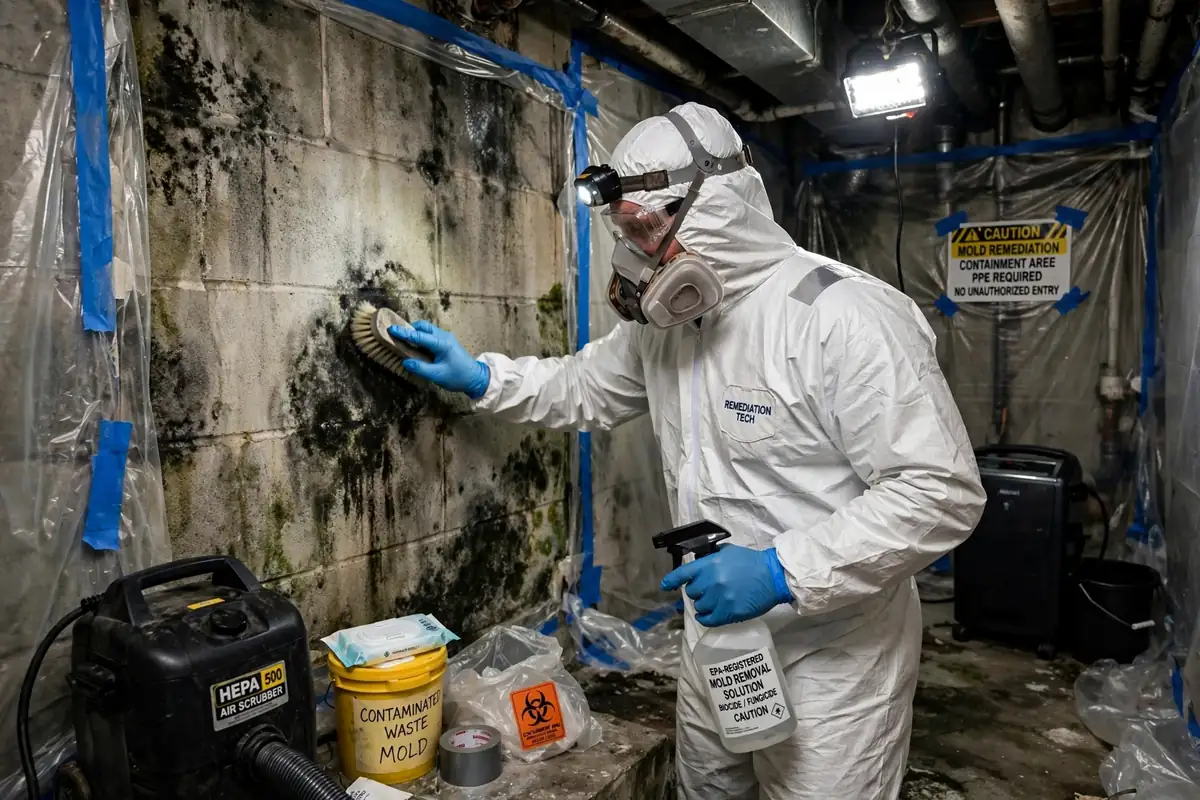
Mold remediation. Floodwater from either river leaves the warm, damp conditions mold needs. We contain affected areas, remove contaminated materials, and treat surfaces so mold doesn't spread through wall cavities and basements after the water recedes.
Sewage cleanup. When heavy rain or high rivers overwhelm older basement drains, sewage can back up into living space. We handle category-3 black water with full PPE, professional-grade disinfectants, and safe disposal of contaminated materials.
Storm damage repair. From tornado-torn roofs to wind-driven rain through broken windows, we secure the structure, extract interior water, and rebuild what the storm damaged — drywall, flooring, trim, and paint.
Our East Moline restoration process
- Call (773) 200-3228 — day or night. During a river event, tell us which river you're closer to; Mississippi-side and Rock River-side jobs are different losses.
- Trace the water's path. Mississippi overbank, Rock River backwater, Sugar Creek drainage, sanitary surcharge, or a burst supply line — the source sets the cleanup protocol and the insurance paperwork.
- Pump it out. Truck-mounted extractors and submersible pumps remove standing water from basements, living areas, and crawl spaces.
- Dry against the meter. Air movers and dehumidifiers run against moisture-mapped targets; equipment comes out only when readings confirm the structure is dry.
- Disinfect and watch for mold. Flood-contacted surfaces are sanitized, compromised porous materials are removed, and we monitor for mold throughout drying.
- Rebuild and document. Damaged finishes are restored to pre-loss condition, and every photo and moisture log is packaged for your adjuster.
Areas we serve in East Moline
We respond 24/7 across East Moline in ZIP 61244 (area code 309): the Greater Downtown districts — "The Quarter" between the Mississippi River and the John Deere Harvester Works, "The Rust Belt" along the 12th Avenue corridor, and "The Bend," the new mixed-use riverfront along Beacon Harbor Parkway & Trail — plus the 15th Avenue Main Street corridor, Runner's Park, and Campbell's Island. We reach you via I-74, I-80, I-88, I-280, and the Illinois Route 92 riverfront. River water rising near the levee or a backup on 15th Avenue — call (773) 200-3228.
Cost factors & insurance claim help
Every East Moline loss is scoped on its facts — we never quote by phone. What shapes the scope: the water category (clean supply water versus Mississippi or Rock River floodwater versus sewage), how much of the structure stayed wet and for how long, and how much drywall, flooring, and insulation must be removed. One East Moline-specific coverage question matters: river overbank flooding typically falls under flood insurance, while burst pipes, wind-driven rain, and sewer backups (with the right endorsement) usually fall under homeowners policies — we help you sort that out before the adjuster calls. We photograph and log everything and work directly with your insurance company from first call to final walkthrough.
Frequently asked questions
Why does East Moline flood from two rivers at once?
The city's floodplain is an abandoned glacial channel, one to three miles wide, connecting the Mississippi and Rock River valleys. It has historically carried floodwaters from both rivers simultaneously — a crest on either river can become a combined event.
What happened during the 2019 record flood?
On May 2, 2019, the Mississippi crested at 22.70 feet at Lock and Dam 15 — the all-time record — and stayed above major flood stage for 41 days, testing levees, ponding areas, and every basement drain in the Quad Cities.
What did the 2016 tornado do in East Moline?
On March 15, 2016, an EF-2 tornado with 130 mph winds hit rural East Moline: 4 homes destroyed, about 40 damaged, 10 minor injuries. Tornadoes admit water through torn roofs and shattered windows — that rain intrusion is a water-damage loss even on skipped streets.
Do the levees protect all of East Moline?
The USACE project, requested after the floods of 1951, 1952, and 1965, built Mississippi and Rock River levees to protect about 3,000 acres against a 200-year flood. But levees manage river overbank — heavy rain, creek drainage, and older basement drains still cause losses behind the walls.
My older East Moline home has a gravity basement drain. Is that a risk?
Yes — the classic Quad Cities vulnerability. Pre-1975 gravity drains are the norm in older riverfront neighborhoods and back up when heavy rain and high rivers overwhelm the system. A backwater valve, a sump pump with battery backup, and our number on the fridge are the practical defenses.
Water Damage in East Moline? We Respond 24/7
Every minute counts. Rapid Water Damage Restoration Illinois dispatches certified technicians across East Moline day and night — with insurance documentation handled for you.
Call (773) 200-3228 NowWater Damage Restoration Services in East Moline
- Our water damage restoration service
- Commercial Water Damage Restoration in East Moline
- Residential Water Damage Restoration in East Moline
- Emergency Flood Cleanup in East Moline
- Storm & Flood Damage Restoration in East Moline
- Ceiling & Wall Water Damage Repair in East Moline
- Sewage Backup Cleanup in East Moline
- Mold Remediation in East Moline
- Burst Pipe & Leak Water Damage in East Moline
- Drying & Dehumidification in East Moline
Nearby Areas We Serve Around East Moline
Helpful Water Damage Guides
- Spring Flooding in Illinois: Home Protection Guide
- What to Do When Your Basement Floods: A Step-by-Step Emergency Guide
Official resources: FEMA FloodSmart (flood insurance) and EPA guide to mold and moisture.