Most Illinois towns sit above their rivers. Granite City sits behind them. The city occupies the American Bottom — the broad, low-lying Mississippi River floodplain of Madison and St. Clair counties — and its protection rests on roughly 37 to 38 miles of Metro East Sanitary District levee running from west of town south past Cahokia. When the Mississippi runs high, that wall of earth is the difference between dry basements and a disaster, and a locally funded $110 million levee restoration finished in 2016 to keep it that way.
That dependency has shaped the city's worst water events. During the summer of 1993, groundwater wells along the Chain of Rocks Canal near Granite City rose to their highest levels since the early 1950s, tracking the river's stages from behind the levee — pressure water finding its way through even when nothing overtops. In spring 2019 the Mississippi at St. Louis stood at 45 feet, 15 above flood stage, and on May 6, 2019 a levee broke south of Illinois American Water's Chouteau Island intake near Granite City, forcing mandatory water conservation across the Metro East. On July 26, 2022, all-time record rainfall put Granite City inside a National Weather Service flash flood warning during the historic St. Louis-area flood.
Founded in 1896 by the Niedringhaus brothers as a steel company town, the city still carries its industrial roots — the U.S. Steel Granite City Works, early immigrant worker housing in Lincoln Place (once "Hungary Hollow"), and blocks of early-1900s bungalows whose aging laterals add their own water risk. When water gets past the defenses — through seepage, overwhelmed pumps, or surcharged storm drains — call (773) 200-3228. Rapid Water Damage Restoration Illinois answers 24/7.
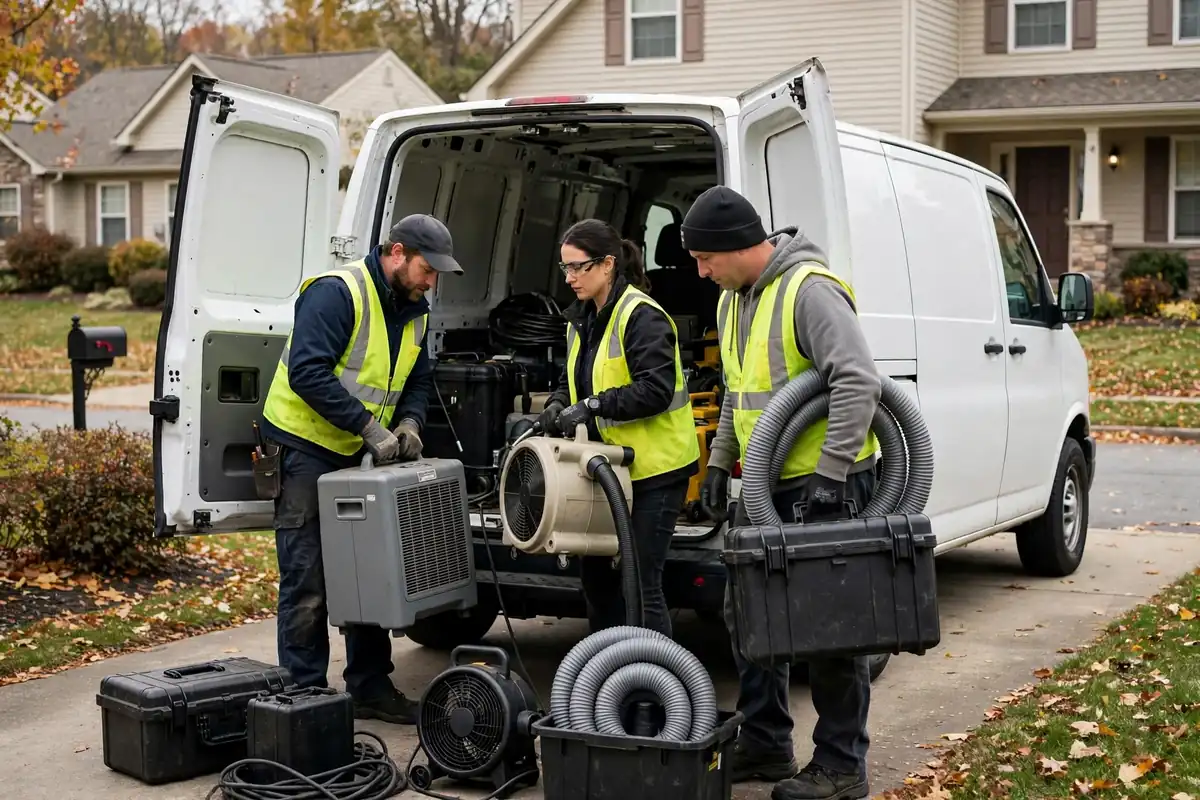
Common Causes of Water Damage in Granite City
- Levee-dependent drainage. Every drop of rain that falls behind the levee must be pumped out to the river. When Mississippi stages stay high, pumping capacity becomes the constraint — interior drainage backups and basement flooding happen even when the levees hold.
- Groundwater seepage under river pressure. In 1993, monitoring wells along the Chain of Rocks Canal tracked the Mississippi's stages and hit their highest levels since the early 1950s. Prolonged high water pushes seepage up through basement floors, foundation cracks, and sump pits.
- Record-breaking flash rain. On July 26, 2022, Granite City sat inside an NWS flash flood warning during the all-time record St. Louis-area rainfall. Storm-drain systems sized for ordinary storms surcharge in events like this one.
- Steel-town-era housing stock. The 1896 planned steel town's older blocks hold early-20th-century bungalows and brick homes — many with aging water and sewer laterals, original supply lines, and foundations that predate modern drainage standards.
- Winter freeze bursts. The January 29–31, 2019 polar vortex set an all-time Illinois record of −38°F, with central Illinois logging 33 to 42 consecutive hours below zero — the classic pipe-burst setup for older homes with uninsulated crawlspaces.
Areas We Serve in Granite City
We serve all of Granite City in ZIP 62040 (area code 618): downtown around Niedringhaus Avenue, West Granite across the railroad lines, the Lincoln Place neighborhood, the Wilson Park area (74 acres, 1.4-mile trail, pool, ice rink), and the Chouteau and Nameoki township edges. We work around the landmarks that define the city: the U.S. Steel Granite City Works, America's Central Port, and Lock and Dam 27 on the Chain of Rocks Canal. Bungalow block or mid-century subdivision — a call to (773) 200-3228 brings a crew that knows the American Bottom's water.
Our Granite City Water Damage Services
Water extraction
High-capacity pumping for basement seepage, pump-backup events, and flash-flood intrusions — contaminated water handled under full containment.
Structural drying
Monitored drying for bungalow and brick construction, with moisture meters verifying walls, subfloors, and framing — seepage-fed basements dry from the inside out, not the top down.
Mold remediation
Levee-country humidity plus lingering seepage breeds mold behind drywall and under flooring. We contain, remove, and treat to IICRC standards.
Sewage cleanup
Heavy-rain sewer backups are a documented Metro East problem. We extract category-3 water in full PPE, remove contaminated porous materials, and disinfect every affected surface.
Storm damage repair
From flash-flood runoff to wind-driven intrusion, we extract the water, dry the structure, and rebuild damaged finishes to pre-loss condition.
Our Restoration Process in Granite City
- Call (773) 200-3228 — around the clock. Active seepage, sewage backup, or flash-flood intrusion moves to the front of our dispatch line.
- Pinpoint how the water arrived. River seepage, pump-backup, storm-drain surcharge, or a failed lateral — the cleanup protocol and your insurance documentation both depend on getting the source right.
- Extract and contain. Standing water comes out fast with truck-mounted and portable equipment; contaminated water is isolated under containment from the start.
- Dry with measurements, not guesses. Air movers and dehumidifiers placed against moisture-mapped targets, with daily readings until every material tests dry.
- Sanitize and block mold. Floodwater and sewage carry contaminants; affected surfaces are disinfected and compromised porous materials removed before mold establishes.
- Rebuild and document. Repairs restore your home to pre-loss condition, with photos and moisture logs packaged for your adjuster.
Cost Factors & Insurance Claim Help
Every Granite City loss is scoped on its facts — no flat quotes. What drives the scope: the water category (clean supply water versus seepage, stormwater, or sewage), the square footage and materials affected, how long they stayed wet, and whether this is a repeat event behind the levee. Two coverage questions matter here most: whether your policy includes a sewer/sump backup endorsement, and — near the river and canal — whether flood insurance applies to your address. We review your coverage, photograph and log everything, and work directly with your insurance company from first call to final walkthrough.
Frequently Asked Questions
The levee held — so why did my Granite City basement flood?
Because levees only stop the river; they don't drain the city. Every drop of rain that falls behind the American Bottom levee must be pumped out to the Mississippi, and when river stages stay high, pumping capacity becomes the limiting factor. Interior drainage backups and basement flooding are the documented recurring risk even when the levees hold — and seepage pressure rises with prolonged high water, as the 1993 canal-well readings showed.
What happened when the Chouteau Island levee broke in May 2019?
On May 6, 2019, a levee broke south of Illinois American Water's Chouteau Island intake facility near Granite City. The breach damaged water infrastructure and triggered mandatory water conservation across the Metro East — including Granite City, Madison, Venice, O'Fallon, Belleville, and East St. Louis. It was a reminder that the city's drinking-water system and its flood protection are both tied to the same river.
Is groundwater seepage a year-round risk here, or only during floods?
It tracks the river, not the rain. During the 1993 flood, groundwater wells along the Chain of Rocks Canal near Granite City rose to their highest levels since the early 1950s, following Mississippi stages. When the river runs high for weeks, seepage pressure under and around foundations rises — which is why Granite City basements can take on water even during stretches without local rain.
I live in an early-1900s bungalow in Lincoln Place. What water risks come with the neighborhood's older homes?
Lincoln Place — originally "Hungary Hollow," the immigrant worker housing of the Niedringhaus steel town — holds some of the city's oldest homes. Expect aging water and sewer laterals, original supply lines, and foundations built before modern perimeter drainage. In a city where everything behind the levee must be pumped, an aging lateral or a failing sump in a century-old house is a single point of failure worth fixing before the next high-water season.
Water Damage in Granite City? We Respond 24/7
Every minute counts. Rapid Water Damage Restoration Illinois dispatches certified technicians across Granite City day and night — with insurance documentation handled for you.
Call (773) 200-3228 NowWater Damage Restoration Services in Granite City
- Our water damage restoration service
- Commercial Water Damage Restoration in Granite City
- Residential Water Damage Restoration in Granite City
- Emergency Flood Cleanup in Granite City
- Storm & Flood Damage Restoration in Granite City
- Ceiling & Wall Water Damage Repair in Granite City
- Sewage Backup Cleanup in Granite City
- Mold Remediation in Granite City
- Burst Pipe & Leak Water Damage in Granite City
- Drying & Dehumidification in Granite City
Nearby Areas We Serve Around Granite City
Helpful Water Damage Guides
Official resources: FEMA FloodSmart (flood insurance) and EPA guide to mold and moisture.