Jacksonville celebrated its 200th birthday in October 2025 — two centuries as the "Athens of the West," and the water-damage story here is written into the architecture. The Downtown Historic District joined the National Register of Historic Places in September 2018, its buildings running from the 1840s through the 1940s with Italianate and Victorian styles especially common; West State Street still holds the 1834 Governor Duncan Mansion — the only building besides Springfield's to serve as an Illinois Governor's Mansion — alongside the 1872 Thompson House, the Ayers House, and the Octagon House at 222 Park Street. Homes like these carry pre-modern foundations, original or aging service laterals, and basements built long before waterproofing existed.
The town's water geography adds two more players: Lake Jacksonville, a 442-to-500-acre drinking-water reservoir with some 21 miles of shoreline about three to four miles south of downtown, and 172-acre Lake Mauvaisterre on the southeast edge. The city wastewater plant's treatment train includes first-flush basins and a combined-sewer-overflow clarifier — the telltale signature of combined sewers that can back up into 19th-century basements during cloudbursts. Rapid Water Damage Restoration Illinois answers 24/7 for Jacksonville at (773) 200-3228.
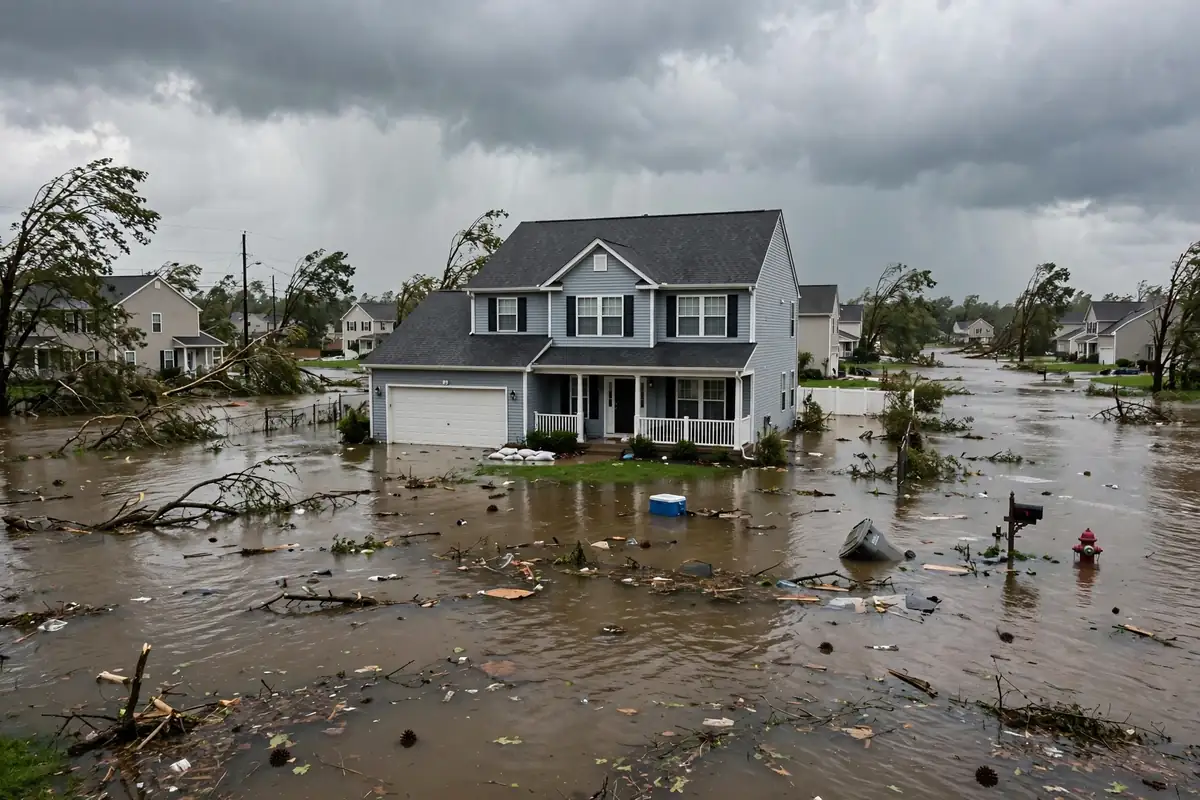
Common causes of water damage in Jacksonville
- 200-year-old housing stock. Italianate and Victorian homes from the 1840s onward, plus former cigar-store commercial buildings downtown, mean stone and brick foundations, old plumbing, and basements never designed for modern storm loads. Central Park's public square was platted in 1825 — the water table under the old core has had two centuries to find every crack.
- Combined sewers. The city wastewater plant — designed for 7.57 million gallons per day average and 15.0 MGD maximum — runs first-flush basins and a CSO treatment clarifier, confirming combined-sewer infrastructure. In heavy rain the system surcharges, and older homes with basement drains take the backup first.
- Lake Jacksonville. The 442–500-acre reservoir is the city's drinking-water supply, with a dam and spillway draining to Big Sandy Creek, a tributary of the Illinois River. Reservoirs are managed for supply, not flood control — sustained rain still pushes high water through the downstream creek corridor.
- Lake Mauvaisterre. The 172-acre lake on the southeast edge underwent a major dredging beginning June 30, 2014 — about 550,000 cubic yards of sediment removed in a $3.7 million project adding roughly 111 million gallons of capacity — a reminder that silted lakes and storm runoff go together here.
- Corridor cloudbursts. In May 2019, floodwaters lingered along Highway 78 south of the Jacksonville airport. On June 24–25, 2021, thunderstorm clusters moved along the I-72 corridor between Jacksonville and Decatur with hourly rainfall rates of 2–3 inches.
- Tornado-season roof damage. An April 19, 2011 supercell produced an EF3 tornado in Girard, just south in Macoupin County, with hail and damaging winds across southern Scott, Morgan, and Sangamon counties — the kind of storm that tears roofs and turns the next rain into an interior-water claim.
Water damage restoration services in Jacksonville
Water extraction
High-capacity pumping for flooded basements, lake-adjacent seepage, sump failures, and burst pipes in historic homes — dispatched around the clock.
Structural drying and dehumidification
Metered drying tuned to 19th-century plaster, old-growth framing, and masonry — verified with moisture readings, because historic materials hold water long after surfaces look dry.
Mold remediation
Damp old basements and wall cavities grow mold fast. We contain, remove, and treat affected materials to IICRC standards and verify the clearance.
Sewage cleanup
Combined-sewer backups are a documented Jacksonville risk. Category-3 water gets full containment, extraction, safe disposal of unsalvageable materials, and thorough disinfection.
Storm damage repair
From hail-torn roofs to wind-driven rain intrusion, we dry the structure and coordinate repairs to pre-loss condition — with documentation your insurer can use.
Cost factors & insurance claim help
No scripted quotes — every Jacksonville loss is scoped on its facts. Historic materials change the math: 1840s–1940s plaster, hardwood, and masonry dry slower and often require more careful demolition than modern drywall. Cost also turns on the water's category — combined-sewer backup means contaminated-water protocols — and how long the structure stayed wet. You'll approve a written, itemized scope before we begin, and we work directly with your insurer with photos, moisture logs, and line-item estimates from first call to final walkthrough.
Areas we serve in Jacksonville
We cover all of Jacksonville in ZIP 62650: the Downtown Historic District and Central Park square, the West State Street mansion row, Illinois College (founded 1829, the state's first college) and the MacMurray campus, the Lake Jacksonville shoreline with its boat ramps, Crimson Trail, and Rocket Trail, Lake Mauvaisterre on the southeast edge, Community Park with its 1907 Big Eli Ferris wheel, and the airport and Highway 78 corridor. Call (773) 200-3228 anytime, day or night.
How We Restore Water-Damaged Homes in Jacksonville
- Call (773) 200-3228 — we answer 24/7. Describe what you're seeing: backup through a basement drain, lake-adjacent seepage, or water through a damaged roof. The source decides our first move.
- Inspect the source and the structure. Our technician traces where the water came from, maps how far it traveled through historic framing and masonry, and gives you a written scope before work starts.
- Extract, then contain. Standing water comes out immediately; if it's sewage or floodwater, we contain the area before drying begins.
- Dry patiently, verify constantly. Air movers and dehumidifiers run against metered targets — Jacksonville's old plaster and masonry dry on their own schedule, and we track them daily.
- Sanitize and stop mold. Affected surfaces are disinfected; contaminated porous materials are removed so mold can't establish behind new finishes.
- Rebuild and document. Damaged materials are replaced to pre-loss condition, and every step is photographed and logged for your insurance claim.
Frequently asked questions
My Jacksonville home is a 19th-century Italianate or Victorian. What are the water risks?
Pre-modern foundations, original or aging service laterals, and basements built before waterproofing — the Downtown Historic District's buildings run from the 1840s through the 1940s. These homes meet two system-level risks: combined-sewer surcharge pushing up through basement drains in heavy rain, and stormwater pooling against old foundations. Watch for floor-drain backups, efflorescence on basement walls, and sump pumps that can't keep pace.
What is a CSO treatment clarifier — and what does it mean for my basement?
The city's wastewater plant includes first-flush basins and a CSO treatment clarifier, which confirms Jacksonville runs combined-sewer infrastructure — one system carrying sewage and stormwater, designed for 7.57 MGD average and 15.0 MGD maximum flow. When cloudbursts exceed capacity, the system can back sewage into homes on the older combined network. A backwater valve and a plumber's review are the standard defenses.
What happened along Highway 78 in May 2019?
A National Weather Service flood statement noted floodwaters receding along Highway 78 south of the Jacksonville airport as a Morgan County flood warning expired on May 1, 2019. Low corridors near the airport take standing water first during heavy-rain events.
Can Lake Jacksonville's dam or spillway affect my property?
Lake Jacksonville is the city's drinking-water reservoir — 442 to 500 acres, about 21 miles of shoreline, with a dam and spillway draining into Big Sandy Creek, a tributary of the Illinois River. It's managed for water supply, not flood control, so sustained heavy rain can still push high water through the downstream creek corridor. If your property sits near Big Sandy Creek, treat major rain events the way riverside owners treat river forecasts.
What was the Lake Mauvaisterre dredging project?
Dredging began June 30, 2014 on the 172-acre lake on Jacksonville's southeast edge: about 550,000 cubic yards of sediment were removed in a roughly $3.7 million project adding some 111 million gallons of capacity. Silted lakes hold less water and shed more runoff — the project restored capacity, not flood control.
Did the 2011 Girard tornado affect Jacksonville?
The April 19, 2011 supercell put an EF3 tornado down in Girard, just south in Macoupin County, while hail and damaging winds swept southern Scott, Morgan, and Sangamon counties. Even without a direct hit, storms like that tear shingles, dent vents, and crack windows — and the next rain finds every opening. After any severe storm, have the attic and roof checked for breaches before water turns them into an interior claim.
Get 24/7 water damage help in Jacksonville
Two centuries of architecture deserve fast, careful restoration. Rapid Water Damage Restoration Illinois answers around the clock across Jacksonville — call (773) 200-3228 now for fast extraction, verified drying, and complete restoration.
Rapid Water Damage Restoration Illinois is a locally owned Illinois water damage restoration company, available 24/7 for emergencies. Our IICRC-trained technicians handle water extraction, structural drying, mold remediation, and sewage cleanup — and we work directly with your insurance company from first call to final walkthrough. Call (773) 200-3228 anytime, day or night.
Water Damage in Jacksonville? We Respond 24/7
Every minute counts. Rapid Water Damage Restoration Illinois dispatches certified technicians across Jacksonville day and night — with insurance documentation handled for you.
Call (773) 200-3228 NowWater Damage Restoration Services in Jacksonville
- Our water damage restoration service
- Commercial Water Damage Restoration in Jacksonville
- Residential Water Damage Restoration in Jacksonville
- Emergency Flood Cleanup in Jacksonville
- Storm & Flood Damage Restoration in Jacksonville
- Ceiling & Wall Water Damage Repair in Jacksonville
- Sewage Backup Cleanup in Jacksonville
- Mold Remediation in Jacksonville
- Burst Pipe & Leak Water Damage in Jacksonville
- Drying & Dehumidification in Jacksonville
Nearby Areas We Serve Around Jacksonville
Helpful Water Damage Guides
- Water Damage From Roof Leaks: Illinois Guide
- What to Do When Your Basement Floods: A Step-by-Step Emergency Guide
Official resources: FEMA FloodSmart (flood insurance) and EPA guide to mold and moisture.