Litchfield's most recent disaster isn't history yet. On May 24, 2024, severe flash flooding hit the city — hard enough for an SBA disaster declaration, opening low-interest disaster loans to residents, condo homeowners, and businesses for uninsured damages. The SBA set up a Disaster Loan Outreach Center at Fire Station 2 on Skyview Drive, and the declaration covered Montgomery County plus seven surrounding counties. St. Francis Hospital was among the affected facilities, and the city ran curbside pickup for flood-damaged items beginning June 10.
Litchfield sits on I-55 between Springfield and St. Louis, where historic Route 66 runs through town — a defining corridor of motels, commercial strips, and rural properties. Just northeast of the city lies Lake Lou Yaeger, a 1,300-acre reservoir created in 1964–1966 by damming the West Fork of Shoal Creek for water supply, recreation, and flood control — the city's public water source, draining through Shoal Creek to the Kaskaskia River. The National Weather Service routinely issues flash flood warnings covering Litchfield, naming the city and Lake Lou Yaeger among affected locations along I-55 exits 52–60. Whether it's the next flash flood or the pipe that bursts this winter, Rapid Water Damage Restoration Illinois answers 24/7 at (773) 200-3228.
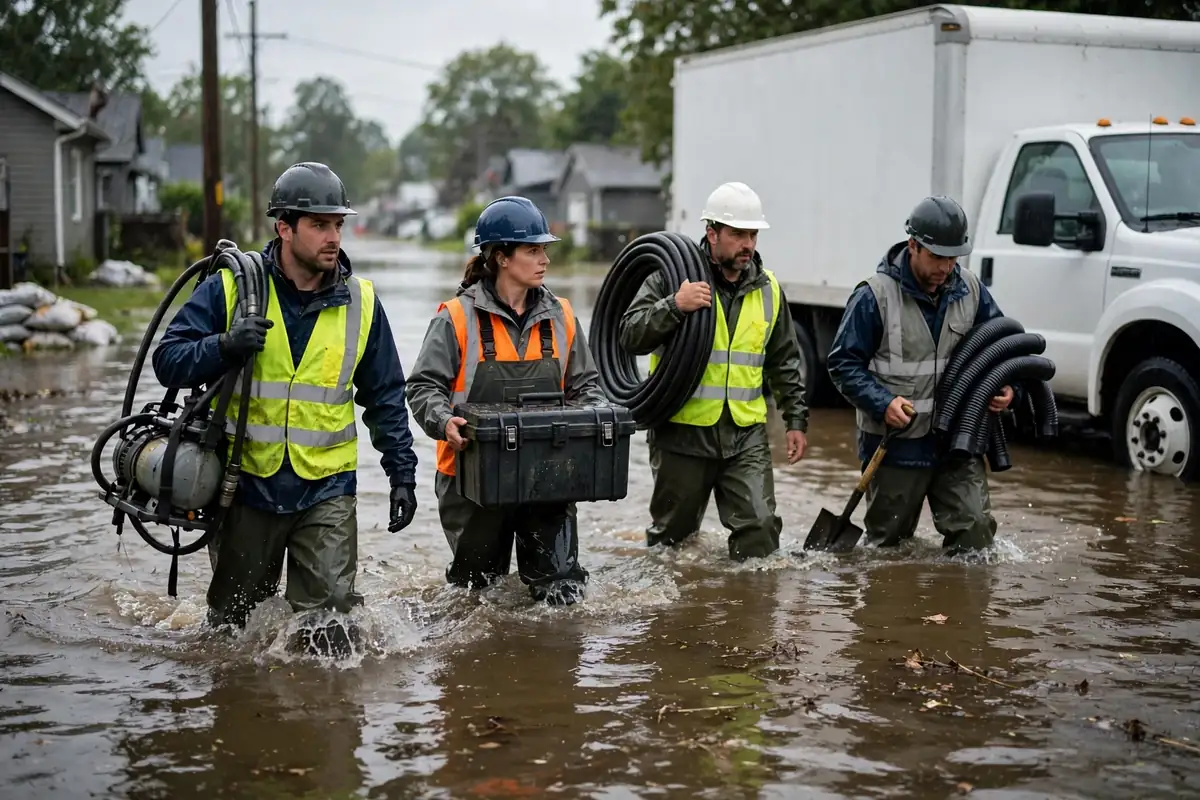
Common causes of water damage in Litchfield
- The May 24, 2024 flash flood. The most recent major flood in Litchfield's history — severe enough for an SBA disaster declaration, hitting homes, businesses, and St. Francis Hospital. The neighborhoods that took water then remain the highest-risk addresses now.
- Recurring flash-flood storms. NWS St. Louis warnings routinely cover Litchfield — one recent warning noted up to 3 inches of rain from Mount Olive to Nokomis. These storms arrive fast and overwhelm low-lying drainage.
- West Fork of Shoal Creek and its tributaries. Lake Lou Yaeger's tributaries — Blue Grass, Shoal, and Shop creeks — feed the watershed running past town. The reservoir was built in part for flood control, but heavy upstream rain can still flood tributaries and downstream reaches.
- Old Route 66 corridor properties. Rural homes south of town on multi-acre lots along Old Route 66 — with ponds, creeks, and outbuildings — sit close to natural water features and far from storm infrastructure; drainage failures there can run longer before anyone notices.
- Winter freeze events. The January 2019 polar vortex and the January 2014 arctic outbreak are the freeze scenarios most relevant to Litchfield's older in-town stock.
Areas we serve in Litchfield
We respond 24/7 across Litchfield in ZIP 62056: downtown along State Street and Illinois Avenue, the older in-town neighborhoods on Illinois Avenue, Hauser, and Clark streets, the north side around Skyview Drive and Fire Station 2, the Eagle Ridge subdivision with lakefront homes on Lake Lou Yaeger, and rural properties along the Old Route 66 corridor south of town. Floodwater or frozen pipes — call (773) 200-3228 anytime, day or night.
Water damage restoration services in Litchfield
Water extraction
High-capacity pumping for flash-flood intrusion, lake- and creek-adjacent flooding, sump failures, and burst pipes — 24/7 across 62056.
Structural drying and dehumidification
Metered drying for Litchfield's older homes — early-1900s character houses with original woodwork, coffered ceilings, and built-ins, plus midcentury ranches — verified daily with moisture readings.
Mold remediation
Post-flood moisture trapped in basements, wall cavities, and lakefront crawlspaces breeds mold fast. We contain, remove, and treat affected materials to IICRC standards.
Sewage cleanup
Category-3 water gets full containment, professional extraction, safe disposal of unsalvageable materials, and thorough disinfection.
Storm damage repair
Wind- and flood-damaged roofing, siding, and interiors — dried out and rebuilt to pre-loss condition.
Frequently asked questions
What happened in Litchfield on May 24, 2024?
Severe flash flooding hit the city — damage was significant enough that Governor JB Pritzker announced an SBA disaster declaration, opening low-interest disaster loans to residents, condo homeowners, and businesses for uninsured damages. The SBA opened an outreach center at Fire Station 2, 1 Skyview Drive, on June 24; St. Francis Hospital was among the affected facilities; and the city ran curbside pickup for flood-damaged items beginning June 10. The declaration covered Montgomery and seven surrounding counties.
I had flood damage but no flood insurance. What are my options?
The May 2024 experience is the local reference point: the SBA declaration made low-interest loans available specifically for uninsured damages to residents, condo homeowners, and businesses. Documenting your damage immediately — photos, measurements, receipts — is essential for any assistance. We work directly with your insurer where coverage exists and provide itemized documentation either way.
Wasn't Lake Lou Yaeger built for flood control?
Partly. The 1,300-acre reservoir — created in 1964–1966 by damming the West Fork of Shoal Creek — was built for water supply, recreation, and flood control. But it manages the lake itself; heavy rain on its tributaries (Blue Grass, Shoal, and Shop creeks) can still flood creek-adjacent properties regardless of lake levels.
What about properties along Old Route 66 south of town?
Rural homes on multi-acre lots with outbuildings, ponds, and creeks. Near natural water features, seepage and sump dependence are the everyday risks, and damage can run longer before it's discovered.
My home is one of Litchfield's older character homes. Any special drying concerns?
Yes. Litchfield's early-1900s homes — original woodwork, coffered ceilings, built-ins, fireplaces — absorb water readily and dry slowly. We dry to verified meter readings rather than surface appearance and document everything for your claim, so original features can be preserved where possible.
Our Litchfield restoration process
- First call, any hour. Flash-flood water, a sewer backup, or a burst pipe each get a different first response.
- Walkthrough assessment. We map the affected area with moisture meters, identify the water source and contamination level, and give you a written scope before work begins.
- Water out. Pumps and extractors remove standing water from basements, ground floors, and crawlspaces — the step that stops damage from compounding.
- Drying by the numbers. Air movers and dehumidifiers run against moisture-mapped targets, with daily readings until walls, floors, and framing test truly dry.
- Clean and clear of mold. Flood- or sewage-contacted surfaces are disinfected; contaminated porous materials are removed so mold can't establish behind fresh paint.
- Rebuild and document. Damaged drywall, flooring, and trim are replaced to pre-loss condition, and every step is photographed and logged for your claim.
Cost factors & insurance claim help
We don't quote water damage from a script — every Litchfield loss is scoped on its facts. Cost turns on the water category, how much of the structure stayed wet and for how long, and the age of the materials — early-1900s woodwork and plaster extend drying time. Flash-flood overbank damage is typically a flood-insurance matter; sudden events like burst pipes fall under homeowners coverage. We provide a free on-site assessment and a written scope before any demolition, then work directly with your insurer with photos, moisture logs, and itemized estimates.
Litchfield flood or burst pipe? Call 24/7
From flash-flood water anywhere in 62056 to a winter pipe burst in a character home downtown, Rapid Water Damage Restoration Illinois answers around the clock in Litchfield. Call (773) 200-3228 now for fast extraction, verified drying, and complete restoration.
Rapid Water Damage Restoration Illinois is a locally owned Illinois water damage restoration company, available 24/7 for emergencies. Our IICRC-trained technicians handle water extraction, structural drying, mold remediation, and sewage cleanup — and we work directly with your insurance company from first call to final walkthrough. Call (773) 200-3228 anytime, day or night.
Water Damage in Litchfield? We Respond 24/7
Every minute counts. Rapid Water Damage Restoration Illinois dispatches certified technicians across Litchfield day and night — with insurance documentation handled for you.
Call (773) 200-3228 NowWater Damage Restoration Services in Litchfield
- Our water damage restoration service
- Commercial Water Damage Restoration in Litchfield
- Residential Water Damage Restoration in Litchfield
- Emergency Flood Cleanup in Litchfield
- Storm & Flood Damage Restoration in Litchfield
- Ceiling & Wall Water Damage Repair in Litchfield
- Sewage Backup Cleanup in Litchfield
- Mold Remediation in Litchfield
- Burst Pipe & Leak Water Damage in Litchfield
- Drying & Dehumidification in Litchfield
Nearby Areas We Serve Around Litchfield
Helpful Water Damage Guides
- How to Prevent Frozen and Burst Pipes During an Illinois Winter
- Water Damage Restoration Cost in Illinois: What Really Drives the Bill
Official resources: FEMA FloodSmart (flood insurance) and EPA guide to mold and moisture.