Palos Hills' own hazard report names a repetitive-flooding zone running along Roberts Road: when it floods, water overflows the road, runs down side streets from 99th Street to 103rd Street, and pours into Lucas Ditch. The stretch from 78th Avenue to Lucas Ditch — 103rd Street north to 99th Street — sits in a FEMA floodplain with what the city calls "repetitive flooding issues which result in hundreds of residences experiencing flooding and water damage." And in "the Hills," the lagoon that keeps Stoney Creek from flooding a subdivision is held back by a levee the city itself describes as old, "in poor shape, and made with guardrail and dirt." This is a town where flood risk is documented in official reports, intersection by intersection.
The 294-acre Moraine Valley Community College campus, Lake Katherine Nature Center and Botanic Gardens, the stair-climbing trails of Swallow Cliff Woods, and the Palos Hills Golf Club mark the city, but its housing is classic mid-century: split-levels, brick ranch homes, brick bungalows, and large 1970s condo complexes, with a median home age of about 41 years. Neighborhoods cluster along Roberts Road, the 81st and 84th Avenue corridors, and around the lagoon and Stoney Creek in "the Hills." If water is coming in, call (773) 200-3228 — we answer 24/7.
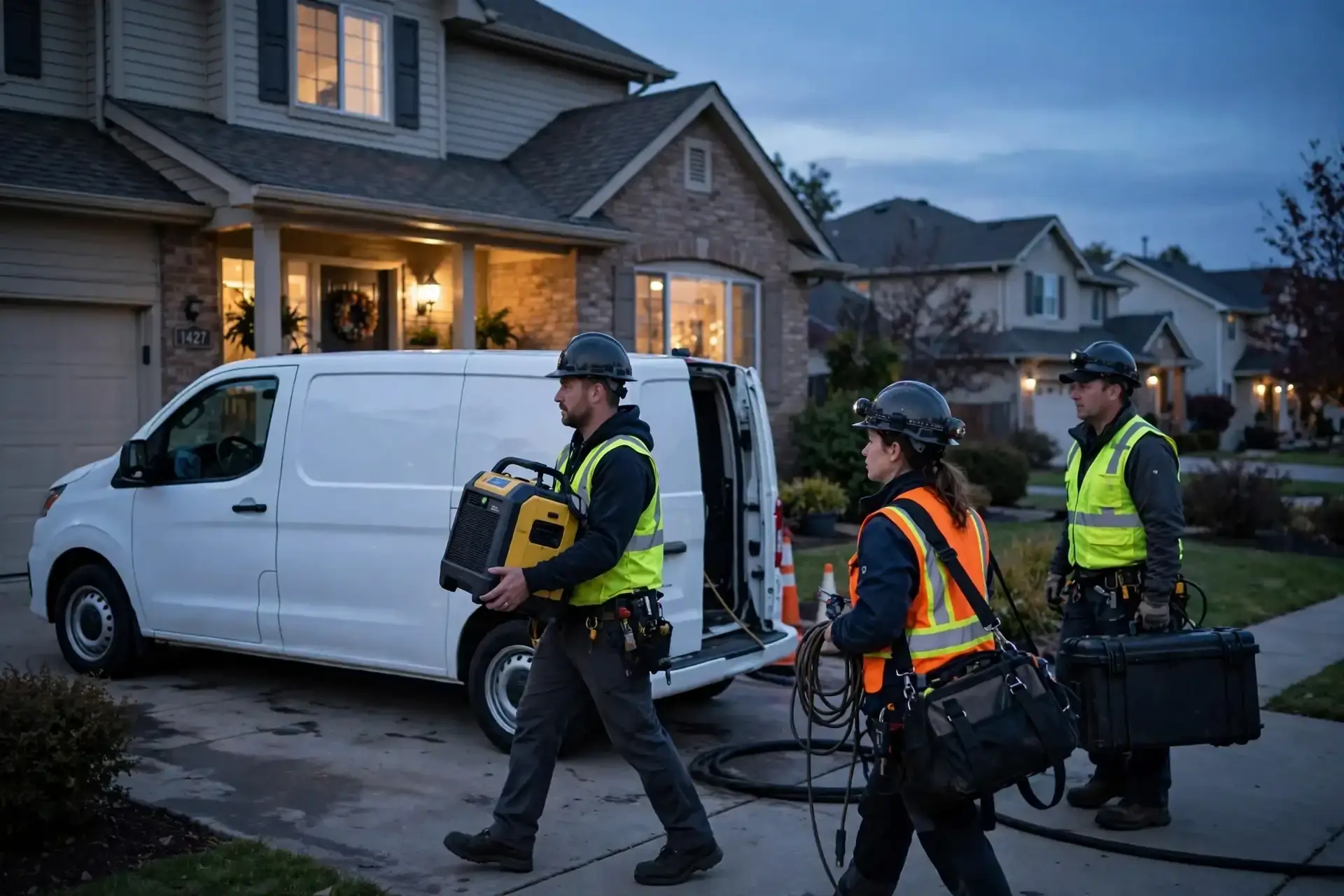
Common Causes of Water Damage in Palos Hills
- Roberts Road overflow and Lucas Ditch backwater. The documented flood path: Roberts Road floods (overflow needing dredging), water runs down side streets from 99th to 103rd Street into Lucas Ditch, and homes across the FEMA floodplain from 78th Avenue to the ditch flood repeatedly.
- The lagoon levee in "the Hills." A guardrail-and-dirt levee "in poor shape" is all that holds Stoney Creek back from a residential subdivision — one aging embankment between normal and a neighborhood flood event.
- Sanitary lift stations over 50 years old. The city is rebuilding lift stations "all over 50 years old" precisely because they lack backup power generation — a power outage during a storm can leave sewage lift stations dead when they're needed most.
- Cal-Sag watershed storms. Sitting in the Cal-Sag Channel watershed to the south, the city takes intense runoff from both its own cloudbursts and upstream development, with a proposed detention basin at HH Golf Course as the only upstream relief on the books.
- Aging 1970s plumbing and condo stacks. Split-levels and brick ranches from the mid-century boom, plus large 1977-era condo complexes, carry original piping, older supply lines, and shared-drain vulnerabilities — one failure can affect multiple units.
Our Palos Hills Restoration Process
- Call (773) 200-3228 — 24/7. Tell us your cross streets; near Roberts Road or the Lucas Ditch flood zone, we arrive with the flood's likely path already mapped.
- Identify the water's source and path. Overbank runoff from Lucas Ditch, lagoon seepage, a lift-station sewage backup, or a burst supply line — the source determines the cleanup protocol and what your insurer covers.
- Extraction and hazard containment. Standing water comes out fast; sewage-contaminated water gets full containment, protective equipment, and disinfection.
- Moisture mapping and structural drying. Mid-century split-levels hide moisture behind paneling, under floating floors, and in finished lower levels. We meter every material and dry to verified targets.
- Mold prevention and sanitizing. Contaminated materials are removed and surfaces disinfected before mold takes hold — critical in homes that sit damp for days waiting for ditch levels to fall.
- Restoration and insurance documentation. Finishes rebuilt to pre-loss condition, with the full photo and moisture-log file your adjuster needs — including documentation of the public infrastructure failure, if that's what sent water in.
Our Palos Hills Water Damage Services
Water extraction
High-capacity pumping for flooded lower levels, split-level living areas, and condo units — from inches of ditch runoff to deep backup events.
Structural drying
Monitored dehumidification for brick ranch, split-level, and bungalow construction — brick, plaster, hardwood — verified dry with meters.
Mold remediation
IICRC-standard containment, removal, and treatment for mold behind drywall, under flooring, and in chronically damp lower levels near the floodplain.
Sewage cleanup
Extraction, sanitization, and safe disposal of contaminated materials after lift-station-driven or storm-surge backups — and disinfection of salvageable surfaces.
Storm damage repair
Repairs for flood, runoff, and wind-driven intrusion across single-family homes and condo units, restored to pre-loss condition.
Areas We Serve in Palos Hills
We serve all of Palos Hills in ZIP 60465: the Roberts Road corridor from 99th to 103rd Street, the 81st and 84th Avenue corridors, the area "in the Hills" around the lagoon and Stoney Creek, and the floodplain east of Roberts Road to Lucas Ditch. Our crews run to the Moraine Valley Community College campus, Lake Katherine Nature Center, Swallow Cliff Woods, and the Palos Hills Golf Club — via Roberts Road, 111th Street, and La Grange Road.
Cost Factors & Insurance Claim Help
No flat quotes — every Palos Hills loss is scoped on its facts: water category (ditch runoff versus raw sewage from a lift-station failure), square footage and construction type, how long materials stayed wet, and whether a condo's shared systems multiply the claim. One local note that matters for insurance: when the water entered because public infrastructure failed — the Roberts Road flood zone, an overwhelmed ditch, a powerless lift station — the cause documentation we collect helps your adjuster place the loss correctly. We review your sewer-backup endorsement with you up front, photograph and log everything, and work directly with your insurance company from first call to final walkthrough.
Frequently Asked Questions
What is Lucas Ditch, and why does Roberts Road flooding end up there?
Lucas Ditch is the drainage channel that receives Roberts Road's floodwater: when the road overflows, water runs down side streets from 99th Street to 103rd Street and into the ditch. The stretch from 78th Avenue to Lucas Ditch — 103rd north to 99th — is the FEMA floodplain where the city reports "hundreds of residences experiencing flooding and water damage." If you live in that grid, your flood path is literally mapped.
The lagoon levee in "the Hills" is made of guardrail and dirt — should I be worried?
That's the city's own description: an old levee "in poor shape, and made with guardrail and dirt" holds the lagoon back from Stoney Creek to protect a subdivision. It's not engineered embankment — it's scrap guardrail and soil, and it's aging. If you live around the lagoon or in "the Hills," treat heavy-rain forecasts as a reason to check that your sump system is working and your number for (773) 200-3228 is handy.
What's the $12 million Roberts Road stormwater project?
A floodplain under and east of Roberts Road is a standing $12 million mitigation project — rerouting stormwater drainage — accepted into MWRD's Phase II Stormwater Management Program back in 2014. For its current status, check with the city; meanwhile, homes along the corridor should assume the flood path is still the flood path.
Why do Palos Hills' aging lift stations matter during a storm?
The city's sanitary lift stations are "all over 50 years old," and the 2021 hazard report flags their lack of backup power generation as a critical power-outage risk. Translation: if a storm knocks out power, lift stations can stop pumping — and sewage can back up toward homes at the worst possible moment. A backup during a storm with the lights out may involve the sewer system, not just stormwater.
I live in one of Palos Hills' large condo complexes — who handles water damage?
The city's 1970s-era condo complexes are effectively year-built 1977, with shared piping and common-area exposure. The practical split: the association owns the building envelope, shared plumbing, and common areas; you own your unit's contents and often its interior finishes. If water enters your unit, call (773) 200-3228 immediately for emergency mitigation — stopping damage protects both your claim and the building — and notify your association and its insurer at the same time. We document unit-by-unit so both claims stay clean.
Palos Hills Flood Emergency? Call (773) 200-3228 — 24/7
Roberts Road runoff, lagoon levee concerns, sewage backup, or a burst pipe in your split-level — Rapid Water Damage Restoration Illinois answers around the clock in Palos Hills. Call (773) 200-3228 now.
Rapid Water Damage Restoration Illinois is a locally owned Illinois water damage restoration company, available 24/7 for emergencies. Our IICRC-trained technicians handle water extraction, structural drying, mold remediation, and sewage cleanup — and we work directly with your insurance company from first call to final walkthrough. Call (773) 200-3228 anytime, day or night.
Water Damage in Palos Hills? We Respond 24/7
Every minute counts. Rapid Water Damage Restoration Illinois dispatches certified technicians across Palos Hills day and night — with insurance documentation handled for you.
Call (773) 200-3228 NowWater Damage Restoration Services in Palos Hills
- Our water damage restoration service
- Commercial Water Damage Restoration in Palos Hills
- Residential Water Damage Restoration in Palos Hills
- Emergency Flood Cleanup in Palos Hills
- Storm & Flood Damage Restoration in Palos Hills
- Ceiling & Wall Water Damage Repair in Palos Hills
- Sewage Backup Cleanup in Palos Hills
- Mold Remediation in Palos Hills
- Burst Pipe & Leak Water Damage in Palos Hills
- Drying & Dehumidification in Palos Hills
Nearby Areas We Serve Around Palos Hills
Helpful Water Damage Guides
Official resources: FEMA FloodSmart (flood insurance) and EPA guide to mold and moisture.