Incorporated in 1911 and strung along Archer Road — one of the oldest roads in Cook County — Justice is a village split in two by I-294. Its flood map reads like a ditch inventory: 75th and Cork, Marion Drive, the 71st Street ditch, the I&M Canal, the 90th Street ditch (shared with Hickory Hills), 80th Street, and Roberts Road to 82nd Avenue (shared with Bridgeview). Rather than accept the list, the village has answered it with a five-part flood mitigation program: a new lift station with backup generators at 75th Street and Cork Avenue plus a forced-main storm sewer from Cork to Garden Lane; new storm sewers and underground stormwater storage on Marion Drive from 82nd Avenue to Roberts Road; improvements to the Justice Overland Flood Route Ditch; 71st Street ditch improvements with a secondary culvert under the railway draining to the I&M Canal; and cleaning and widening of the Justice Ditch.
Progress is visible: the May 2023 newsletter announced the Marion Drive flood control project would start early — "extra water will be stored underground" — and that Phase 1 of the 75th Street and Cork Avenue drainage work had begun, alongside the 90th Street ditch shoring project. Storms here can be violent too: on May 20, 2014, severe thunderstorms with large hail and wind damage overturned a semi on I-294 near the 82nd Street Toll Plaza. The housing stock is modest mid-century — ranch and raised-ranch homes, brick bungalows, and some apartment complexes — and landmarks include the I&M Canal on the northwest border, Veterans Memorial, Roberts Park Fire Protection District Station 1 at 8611 S. Roberts Rd., the Justice Public Library, and the Lipinski Center, which doubles as emergency shelter. If water is coming in, call (773) 200-3228 — Rapid Water Damage Restoration Illinois answers 24/7.
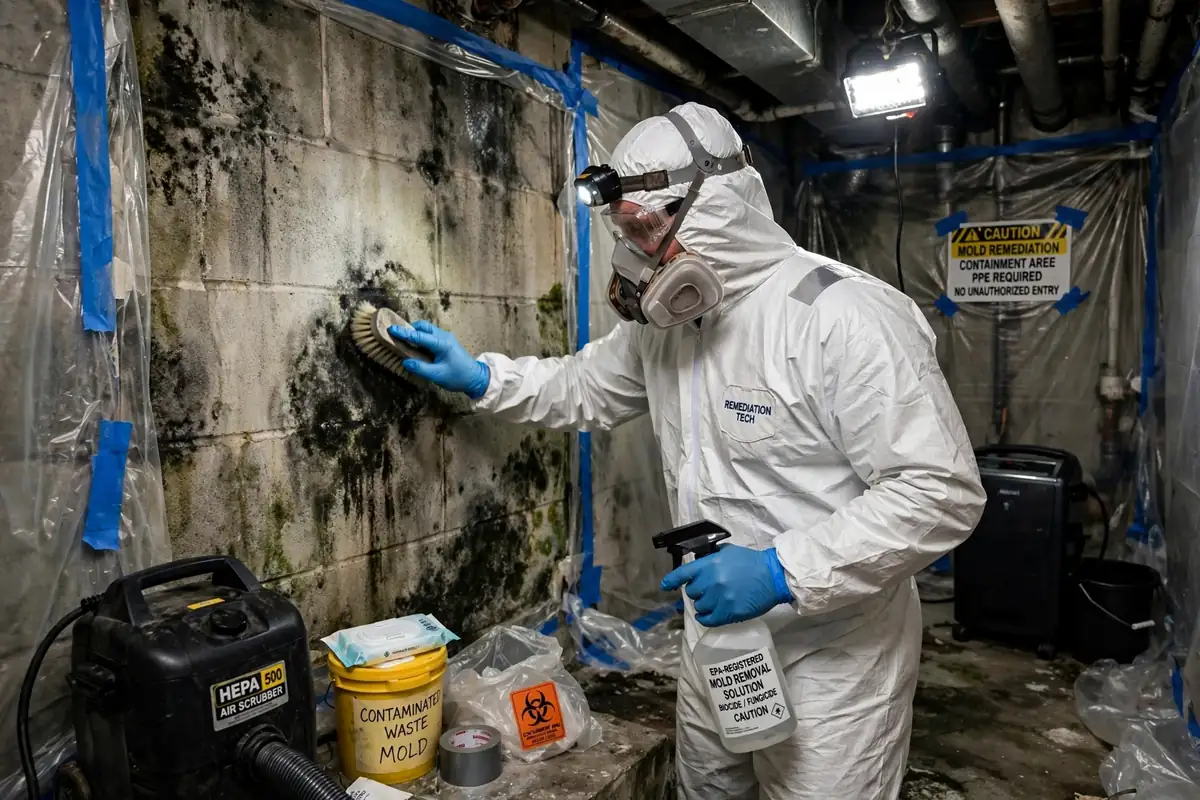
Common Causes of Water Damage in Justice
- Named ditch flooding. The village's 2021 hazard report names six flood-prone spots — 75th and Cork, Marion Drive, the 71st Street ditch, the I&M Canal corridor, the 90th Street ditch, and 80th Street — plus the Roberts Road to 82nd Avenue zone shared with Bridgeview. Justice drains through open ditches, not buried storm sewers.
- Combined-sewer backup pressure. Justice sits in the MWRD combined-sewer service area, so intense rain surcharges a system carrying stormwater and sanitary waste together — basement drains are a backup point when the mains fill.
- Exposed-ditch freeze risk. Open ditches and the Justice Overland Flood Route can ice over, block, and back water up during extended cold — the village's own report flags the whole community as susceptible to snow, blizzards, ice storms, and extreme cold.
- The tollway divide. I-294 cuts the village into east and west drainage systems, and the two sections don't drain the same way — a cloudburst that ponds on one side can run clean on the other.
- Mid-century piping in older stock. Modest ranch and raised-ranch homes from the mid-20th century carry aging supply and drain lines — freeze-crack and slow-leak failures that soak wall cavities for weeks before anyone notices.
Areas We Serve in Justice
We serve all of Justice in ZIP 60458: the east section and west section on either side of I-294, the Archer Road corridor, the Marion Drive and 75th & Cork project zones, and the blocks around the 71st Street and 90th Street ditches. Our crews run to Veterans Memorial, the Justice Public Library, Roberts Park Fire Station 1 at 8611 S. Roberts Rd., and the I-55/I-294 interchange — via Archer Road, Roberts Road, and 79th Street.
Our Justice Restoration Process
- Call (773) 200-3228 — 24/7. Active flooding, sewage, or burst pipes get dispatched first — and tell us which side of the tollway you're on.
- Source and water typing. Ditch overbank, combined-sewer surcharge, a burst line, or ice-blocked drainage — the source sets the cleanup protocol and what your policy covers.
- Extraction with containment. Standing water comes out fast; sewage-contaminated events get full containment, protective equipment, and disinfection.
- Moisture mapping and monitored drying. We meter hidden moisture in walls, subfloors, and finished lower levels, then dry to verified targets with air movers and dehumidifiers.
- Sanitizing and mold prevention. Contaminated materials are removed and surfaces disinfected before mold establishes — the failure point in homes that sit damp waiting for ditch levels to drop.
- Restoration and claim documentation. Finishes rebuilt to pre-loss condition, with the photo and moisture-log file your adjuster needs.
Our Justice Water Damage Services
Water extraction
High-capacity pumping for flooded lower levels, ranch-home living areas, and apartment units — from ditch overbank to deep backup events.
Sewage cleanup
Extraction, sanitization, and safe disposal of contaminated materials after combined-sewer backups — and disinfection of salvageable surfaces.
Structural drying
Monitored dehumidification for ranch, raised-ranch, and bungalow construction — brick, plaster, hardwood — verified dry with meters.
Mold remediation
IICRC-standard containment, removal, and treatment for mold behind drywall and paneling, under flooring, and in homes with repeat-wetting histories.
Storm damage repair
Repairs for flood, runoff, and wind-driven damage — including the hail and wind events that hit the corridor — restored to pre-loss condition.
Frequently Asked Questions
What is the village's five-part flood mitigation program?
It's Justice's official answer to its flood map, described in the village's 2019 hazard annex: (1) a new lift station with backup generators at 75th St. & Cork Ave. plus a forced-main storm sewer on 75th from Cork to Garden Lane; (2) new storm sewers and underground stormwater storage on Marion Drive from 82nd Ave. to Roberts Rd.; (3) Justice Overland Flood Route Ditch improvements — cleaning, deepening, widening, bank stabilization; (4) 71st St. ditch improvements with a secondary culvert under the railway draining to the I&M Canal; (5) Justice Ditch (72nd St. to the 71st St. ditch) cleaning and widening. Five distinct projects because the flooding comes in five distinct ways.
How does the new lift station at 75th & Cork protect my home?
The project adds a new lift station — with backup generators — at 75th Street and Cork Avenue, plus a forced-main storm sewer on 75th from Cork to Garden Lane. A lift station moves water where gravity can't, and the generators mean it keeps working during the power outages that arrive with the worst storms. The May 2023 newsletter announced Phase 1 of this work had begun. If you live near 75th & Cork, this is the infrastructure built for your block.
What does "extra water will be stored underground" mean for Marion Drive?
That's the village's own phrase from the May 2023 newsletter announcing that the Marion Drive flood control project would start early. Underground stormwater storage — large buried chambers — holds surge water during a storm and releases it slowly afterward, keeping it out of streets and basements. It's flood control you drive over every day without knowing. If you live on Marion Drive, the project is your long-term defense; call (773) 200-3228 for what's happening now.
Does the I&M Canal flood homes on the northwest border?
The I&M Canal forms the village's northwest border, and the 2021 hazard report lists the canal among the village's flood-prone areas. The 71st Street ditch improvements specifically add a secondary culvert under the railway draining to the canal — meaning the canal is part of the drainage system, not just scenery. Homes near the canal and the railway corridor should treat heavy-rain forecasts as actionable.
Cost Factors & Insurance Claim Help
No flat quotes — every Justice loss is scoped on water category (ditch runoff versus combined-sewer backup), square footage and materials, how long they stayed wet, and whether apartment-complex exposure multiplies the claim. Justice's mitigation program helps your paperwork: water from a documented ditch or surcharge zone — or during a documented storm — is easier to establish for your adjuster. We review your coverage, including sewer-backup endorsements, up front, document everything, and work directly with your insurance company from first call to final walkthrough.
Justice Flood Emergency? Call (773) 200-3228 — 24/7
Ditch flooding, sewer backup, storm damage, or a burst pipe on either side of the tollway — Rapid Water Damage Restoration Illinois answers around the clock in Justice. Call (773) 200-3228 now.
Rapid Water Damage Restoration Illinois is a locally owned Illinois water damage restoration company, available 24/7 for emergencies. Our IICRC-trained technicians handle water extraction, structural drying, mold remediation, and sewage cleanup — and we work directly with your insurance company from first call to final walkthrough. Call (773) 200-3228 anytime, day or night.
Water Damage in Justice? We Respond 24/7
Every minute counts. Rapid Water Damage Restoration Illinois dispatches certified technicians across Justice day and night — with insurance documentation handled for you.
Call (773) 200-3228 NowWater Damage Restoration Services in Justice
- Our water damage restoration service
- Commercial Water Damage Restoration in Justice
- Residential Water Damage Restoration in Justice
- Emergency Flood Cleanup in Justice
- Storm & Flood Damage Restoration in Justice
- Ceiling & Wall Water Damage Repair in Justice
- Sewage Backup Cleanup in Justice
- Mold Remediation in Justice
- Burst Pipe & Leak Water Damage in Justice
- Drying & Dehumidification in Justice
Nearby Areas We Serve Around Justice
Helpful Water Damage Guides
Official resources: FEMA FloodSmart (flood insurance) and EPA guide to mold and moisture.