Draw a line through Lombard and you split the city between two waters: rain falling on one side drains toward the East Branch of the DuPage River — a 24-mile river whose 82-square-mile watershed includes Lombard, Glen Ellyn, and Downers Grove — while rain on the other side, via Ginger Creek, feeds the Salt Creek watershed. That divide is Lombard's flood story in miniature: not one creek to watch, but two systems, each with its own record floods. The East Branch corridor has seen the 1996 deluge (up to 17 inches in 24 hours, Interstate 55 itself flooded), September 2008's 51 consecutive hours of rain, and April 2013's record stages. Lombard has no single nationally reported disaster of its own — which means flood planning here is built on watershed history rather than one headline event. The housing stock is old enough to have seen all of it: median year built 1966, ranches, split-levels, and brick colonials across North and South Lombard. When water reaches your home, Rapid Water Damage Restoration Illinois answers 24/7. Call (773) 200-3228.
Common causes of water damage in Lombard
- The East Branch DuPage River. It flows roughly 24 miles south-southwest through residential and commercial Lombard; its watershed of about 82 square miles includes Bloomingdale, Glendale Heights, Glen Ellyn, Downers Grove, Lisle, Westmont, Woodridge, and Naperville, with Glencrest Creek among its Lombard tributaries.
- A city on a watershed divide. Through Ginger Creek — a Salt Creek-watershed stream covering Downers Grove, Lombard, Oak Brook, Oakbrook Terrace, and Westmont — parts of Lombard drain to Salt Creek instead of the East Branch.
- Regional record events. 1996: up to 17 inches in 24 hours; the DuPage mainstem flooded, including Interstate 55. September 2008: 51 consecutive hours of rain; $2.3 million in DuPage County FEMA aid. July 2010: a 100-year-plus regional storm. April 2013: 5–10 inches in two days; DuPage County in the state disaster declaration; $14.8 million in FEMA aid and a $7 million HUD recovery allocation.
- Localized flooding. In 2021, DuPage County Stormwater Management approved temporary construction easements for small-scale drainage projects to reduce localized flooding in unincorporated Lombard.
- Aging mid-century housing. city-data.com puts Lombard's median year built at 1966 — the classic interior-loss profile of aging supply lines, water heaters, and drain systems, plus older downtown homes from the 1920s–50s.
- Downstream protection limits. Just downstream in Lisle, the 1960s River–Dumoulin levee (built for 50-year protection, since settled and eroded) is backed by four pump stations built in 2009, between I-88 and Maple Avenue — directly downstream of Lombard's reach.
Our Lombard water damage services
Water extraction
East Branch overbank, Ginger Creek rises, localized flooding, backups, or burst pipes — high-capacity pump-out with containment.
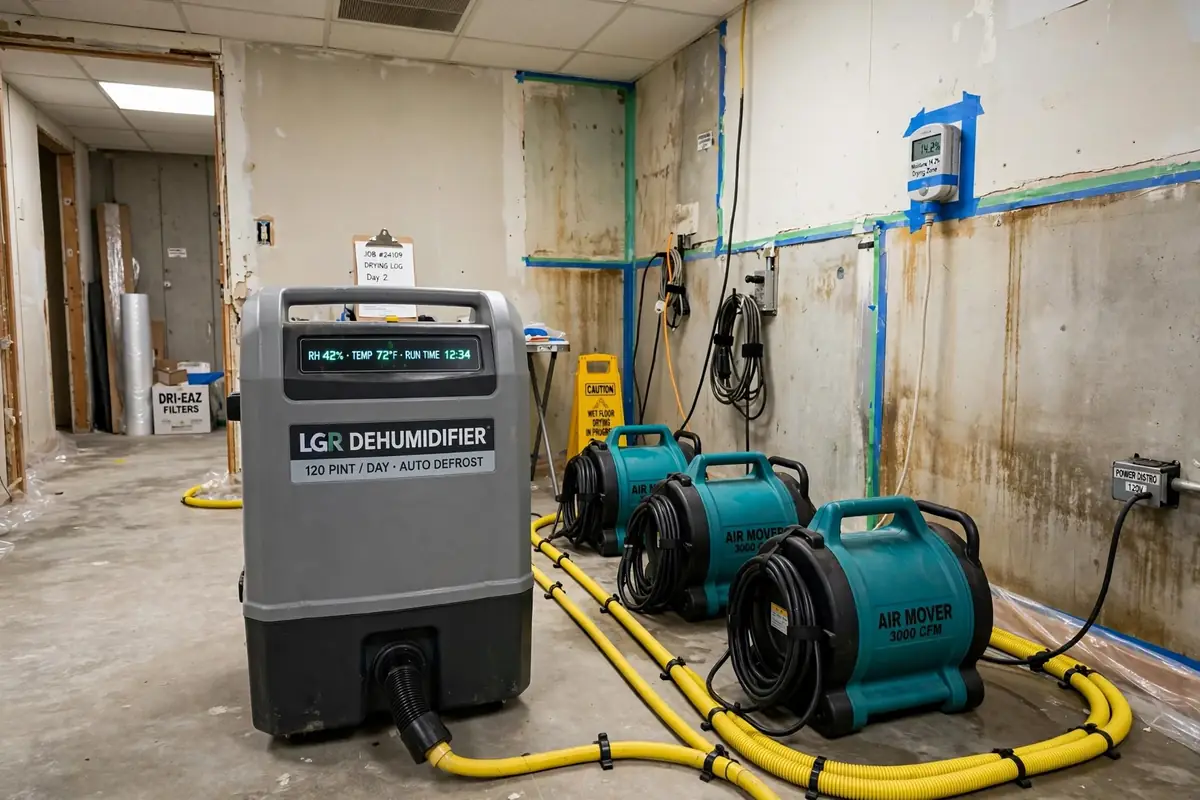
Structural drying
Metered dehumidification for 1950s–70s ranches, split-levels, and brick colonials — verified with moisture meters, never assumed dry.
Mold remediation
We contain, remove, and treat mold in wall cavities and basements to IICRC standards after floods, backups, and slow leaks.
Sewage cleanup
When systems back up into living space, we extract category-3 water in full PPE, remove contaminated porous materials, and disinfect every surface.
Storm damage repair
Wind- and hail-damaged roofing, siding, and windows are sealed, the intrusion extracted and dried, and the home rebuilt to pre-loss condition.
Frequently asked questions
What does it mean that Lombard sits on a watershed divide?
Most of Lombard drains to the East Branch of the DuPage River (about 82 square miles of watershed), but via Ginger Creek, parts of the city fall in the Salt Creek watershed — the same system as Downers Grove, Oak Brook, Oakbrook Terrace, and Westmont. Your flood risk and insurance mapping depend on your side of the divide.
Why isn't there one famous Lombard flood the way Elmhurst has the quarry?
No nationally reported flood event was documented for Lombard — its water story is regional watershed history, not one headline disaster. The East Branch benchmarks (1996, September 2008, July 2010, April 2013) are the planning baseline.
What is DuPage County's cost-share drainage program?
The county's Cost-Share Drainage Assistance Program reimburses 50% — up to $5,000 — of eligible private-property drainage work: grading, storm sewer, dry wells, and sump-pump/downspout connections. Priority goes to first-floor damage, then basement or crawlspace damage, then septic backup.
What happened on the East Branch in 1996, 2008, and 2013?
1996: up to 17 inches of rain in 24 hours — the DuPage mainstem flooded, including Interstate 55. September 2008: 51 consecutive hours of rain and $2.3 million in DuPage County FEMA aid. April 2013: up to 7 inches in 24 hours with record gage stages — DuPage County entered the state disaster declaration with $14.8 million in FEMA Individual Assistance.
What are Glencrest Creek and Ginger Creek?
Glencrest Creek is an East Branch tributary running through Lombard itself. Ginger Creek is a Salt Creek-watershed stream covering Downers Grove, Lombard, Oak Brook, Oakbrook Terrace, and Westmont — the creek that puts part of Lombard on the Salt Creek side.
Cost factors & insurance claim help in Lombard
No flat quotes — your loss is scoped on its facts: the water category, the square footage and materials affected, how long they stayed wet, and the home's age. River and creek flooding is generally a flood-insurance matter; burst pipes, wind-driven rain, and sewer backups (with the backup endorsement) typically fall under homeowners coverage — we review your coverage with you. One local resource: DuPage County's Cost-Share Drainage Assistance Program reimburses 50% (up to $5,000) of eligible private-property drainage work like grading, dry wells, and sump-pump connections, prioritized for first-floor damage. And as always, we document everything and work directly with your insurance company from first call to final walkthrough.
Areas we serve in Lombard
We serve all of Lombard in ZIP codes 60148 and 60181: North Lombard near Lilacia Park and the Lilac Time festival grounds, South Lombard around Yorktown Center and Four Seasons Park, and the downtown district — plus unincorporated Lombard areas where the county has targeted drainage projects. Our crews run from the Helen Plum Library to Lombard Common water park. Call (773) 200-3228.
Our Lombard restoration process
- Emergency intake call. Phone (773) 200-3228 day or night — active flooding and sewage backups get first dispatch priority.
- Source tracing and damage survey. We identify where the water came from and map its spread with meters and thermal imaging, then give you a written plan.
- Water removal and monitored drying. Standing water is extracted, then air movers and dehumidifiers run against measured targets until every material tests dry.
- Disinfection, repairs, and final documentation. Contaminated surfaces are sanitized, finishes rebuilt to pre-loss condition, and the full photo and moisture-log file goes to your insurer.
Water Damage in Lombard? We Respond 24/7
Every minute counts. Rapid Water Damage Restoration Illinois dispatches certified technicians across Lombard day and night — with insurance documentation handled for you.
Call (773) 200-3228 NowWater Damage Restoration Services in Lombard
- Our water damage restoration service
- Commercial Water Damage Restoration in Lombard
- Residential Water Damage Restoration in Lombard
- Emergency Flood Cleanup in Lombard
- Storm & Flood Damage Restoration in Lombard
- Ceiling & Wall Water Damage Repair in Lombard
- Sewage Backup Cleanup in Lombard
- Mold Remediation in Lombard
- Burst Pipe & Leak Water Damage in Lombard
- Drying & Dehumidification in Lombard
Nearby Areas We Serve Around Lombard
Helpful Water Damage Guides
- Does Homeowners Insurance Cover Water Damage in Illinois?
- Water Damage Restoration Cost in Illinois: What Really Drives the Bill
Official resources: FEMA FloodSmart (flood insurance) and EPA guide to mold and moisture.